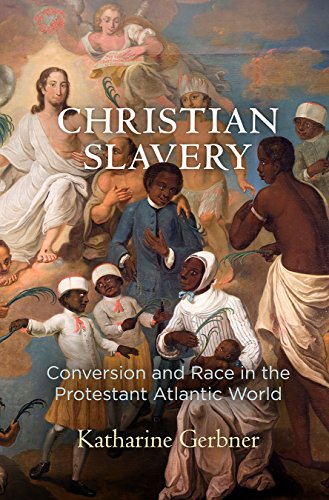
Gerbner, Katharine. Christian Slavery: Conversion and Race in the Protestant Atlantic World. Early American Studies. Philadelphia: University of Pennsylvania Press, 2018.
CATEGORIES: Atlantic Ocean History, Race History, British History, Christian converts, European History, Religious history, Slavery and the church, Slavery and the church, Slave history, Protestant missions, missionary work and slavery
PLACE: Atlantic World, West Indies (especially Barbados), colonies of continental North America
TIME PERIOD: 1650-1740
SUMMARY:
Before white supremacy came “Protestant Supremacy.” In Christian Slavery (2018), Katherine Gerbner offers a revisionist history of Christianity and slavery in the seventeenth-century Atlantic world. She interrogates the historical narrative of Christian missionaries beneficent intentions and anti-slavery views by evaluating journals, letters, court records, and archives in various languages and countries, particularly in the West Indies where such missions first occurred. Protestant missionaries reworked ideas about the acceptibility of Christian slavery when they met planter resistance to slave conversions due to their “Protestant Supremacy.” Slave owners believed that African slaves could not be true Protestants, an ideology that dominated the period (1600-1800) in which Anglican, Moravian, and Quaker planters believed that Protestantism was central to their identity as masters and free men. Gerbner turns the dominant narrative of missionaries’ antislavery beliefs on its head by arguing that planters and missionaries battled over the Protestant Supremacy of the planters and the Christian Slavery of the missionaries. Far from being anti-slavery, Anglican, Quaker, and Moravian missionaries worked to bring slavery in line with Christianity, and they effectively created legislation to this effect. Before Quakers they were abolitionists, they were staunchly proslavery.
Missionaries also provided a rationale for colonization and slavery. The planters argued, partly because by this time it was unacceptable for Christians to own Christian slaves in Europe, that conversion would could cause the slaves to rebel and behave poorly, though there was no evidence to this effect. Slavery was acceptable because the slaves were heathens. Christians had rights; heathens did not. Planters were physically and verbally abusive to missionaries, who, eager to convert slaves and dependent on the planters permission, repositioned their beliefs to promote Christian slavery (which had been debated up to this point). These beliefs were not simply used to persuade planters, but were codified in legislation, which over time created a legal institution of race-based slavery in the West Indes and United States. Rather than creating a foundation for anti-slavery movements, these missionaries created ideologies of paternalism and Christian justification for slavery used in proslavery arguments of the 18th and 19th centuries.
Gerbner also engages the contested concept of “conversion” by noting that Protestant sects had different ideas about what constituted conversion, as well as what it meant to the converted enslaved and free Blacks. Her study is the first to focus on Black slave conversions before the revivals of the 18th and 19th centuries. The baptism of blacks challenged the major justificaiton for slavery in the 17th century—they were not Protestants. This cause a shift of racial terminology that came to justify slavery. The roots of white supremacy are found in “Protestant Supremacy”; the former term is still embedded with religious signification.
Gerbner’s is an impressive account of the missionary responsibility for creating Protestant supremacy, and this is what sets her narrative apart from previous historians who have addressed it. She corrects Frey and Wood’s argument (Come Shouting to Zion, 1998), which ignores the importance of earlier conversions and overstates the importance of the Great Awakening and the “emotive worship” aspect of slave conversion. While the voices of free and enslaved Blacks are faint, this is more likely a fault of the archives than Gerber, who uses some letters and accounts by African American sources.
Chapter 1 Christian Slaves in the Atlantic World
This chapter is a brief review of Christian slavery to the 17th Century and provides a foundation for Gerbner’s argument.
Chapter 2 Protestant Supremacy
Gerbner uses a tract first read in Barbadian Anglican churches in 1662, “The Act for the better ordering of Negroes,” to illustrate the position of Anglican religion in promoting slavery and Protestant Supremacy, countering arguments that Barbadian planters were not religious.
Chapter 3 Quaker Slavery and Slave Rebellion
Quaker leader Geroge Fox encouraged slavery by criticising Anglican planters for not converting their slaves in 1671, which an Anglican minister repeated, causing a larger pressure for converting slaves. Further, Anglicans blamed Quakers for inciting rebellions by bringing Blacks into their meetings and so passed “An Act to prevent the people called Quakers, from bringing Negroes to their Meeting” in 1676.
Chapter 4 From Christian to White
In other places, slaves occasionally won baptism in other plantation colonies, usually “chief slaves” on a plantation, or the slave children of masters, although planters were against largescale conversions, as it threatened their fragile society. This was a very small fraction of slaves—less than 1%. These conversions challenged Protestant Supremacy and planters began to shift the language of mastery to race rather than religion. By 1700, slavery was justified by race, though the ideology of Protestant Supremacy remained. Barbados passed “an Act to keep inviolate, and preserve the Freedom of Elections” which added “white man” to “professing the Christian religion in 1697.
Chapter 5 The Imperial Politics of Slave Conversion
Gerbner uses the example of Christopher Codrington, governor-general of the Leeward Islands, to demonstrate that while planters reconsceived slavery in terms of race they still resisted most slaves from Christian practices as as such, Gerbner argues, shows the maintenance of Protestant whiteness. The transition to white supremacy took decades and slaveholders still required proslavery arguments from missionaries and other religious figures to feel comfortable with slave conversion. Codrington found it difficult to reconcile slavery and his Christianity, though he tried. He tried to convince planters that Christian slave communities were safe and not rebellious, but he also understood that it was a complex moral, political, and imperial matter.
Chapter 6 The SPG and Slavery
Codrinton fought against and then worked with the French, who provided an example of Christian slavery in the continetnal colonies of North America. Influenced by the Catholic colleges, he bequeathed two plantations and hundreds of slave to the Anglican missionary society, the Society for the Propagation of the Gospel in Foreign Parts (SPG) to become a missionary college for slaves when he died in 1710. Here, the first Anglican missions to slaves began. Two French Protestants, Elias Neau and Francis Le Jau worked to make slave conversion more acceptable, the former by pursuing legal means to support slave Christianity and the latter by adding a pledge to the baptism that made clear Christian slaves were not free. Even so, Neau was blamed for a 1712 slave uprising, “demonstrating the persistence of Protestant Supremacy in the early eighteenth century.” The mission of the SPG remained devoted to the business of slavery rather than the missionizing of slaves.
Chapter 7 Inner Slavery and Spiritual Freedom
The Anlicans “master-centered” outreach to Christianize slaves took no account of why slaves might wish to convert. The Pietist Moravians, part of the Great Awakening, built on the networks laid by Anglican missionaries but had markedly new strategies, which involved the revivalist emphasis on feeling Christ in the heart. They argued with the existing Black Christians in the West Indies, most of whom had been favored slaves who were converted by their masters. They formed an elite of slave society and were too interested, the Moravians believed, in education and textual Christianity, similar to their criticism of confessional Lutheranism in Germany. Their work in the West Indies caused a shift in both missions and Black Christianity, introducing a radical, revivialist Christianity.
Chapter 8 Defining True Conversion
Moravian missions shifted their strategies over the years. Once leaning on reading and writing lessons for converts, they later forbid them altogether. Marriage policy changed from monogamy only to an acceptance of polygamy. These changes were the result of pressure from both converts and planters.
Epilogue. Proslavery Theology and Black Christianity
Gerbner traces what many consider to be the “first formal defense of slavery in the Atlantic world,” “A Letter to the Inhabitants of Maryland, Virginia, North and South Carolina” written by George Whitefield in 1740, to the developments of the three missionary groups, the Quakers, the Anglicans, and the Moravians, in concert with enslaved Blacks and slave owners. Whitefield, a revivalist leader, condemned slave owners for refusing to Christianize their slaves. He argued with proslavery colonists in Georgia, which had been the first founded without slavery. The early period of Protestant missionizing work in the Americas was far from abolitionist, as has previously been argued. Instead it was the foundation of later proslavery rhetoric.
HISTORIOGRAPHY
Frey, Sylvia Rae, and Betty Wood. Come Shouting to Zion: African American Protestantism in the American South and British Caribbean to 1830. Chapel Hill: The University of North Carolina Press, 1998.
Glasson, Travis. Mastering Christianity: Missionary Anglicanism and Slavery in the Atlantic World. New York: Oxford University Press, 2012.
Morgan, Edmund S. American Slavery, American Freedom : The Ordeal of Colonial Virginia. New York: W.W. Norton & Co, 2003.
Raboteau, Albert J. Slave Religion: The “Invisible Institution” in the Antebellum South. Oxford ; New York: Oxford University Press, 1975.