CATEGORIES: Oxford History of the United States (i.e. Elite White Male History), Political History, Antebellum U.S. History, democracy, U.S. Government, Jacksonian America, Western Expansion, Economic History, Religion, Reform, Whigs, Communications Revolution, 19th-Century Social Change, Economic Conditions.
PLACE: United States
TIME PERIOD: 1815 (post-War of 1812) – 1848 (post-Mexican-American War).
TAKEAWAY: If only the Whigs had won.
SUMMARY:
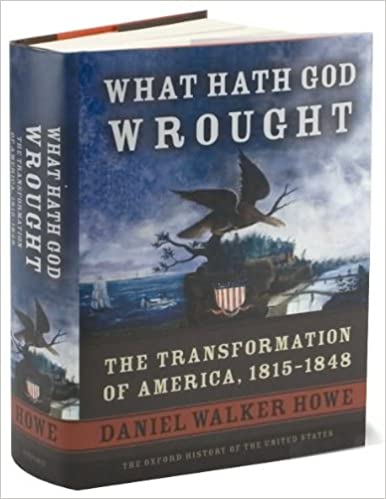
In this Pulitzer-Prize winning synthesis of early 19th-Century U.S. History dedicated to the long-dead President John Quincy Adams, Daniel Walker Howe pushes against the narratives of Charles Sellers (whose text for this installment of the Oxford History of the United States was rejected for not sufficiently embracing capitalism), Sean Wilentz, and Arthur Schlesinger Jr. Jacksonian Democracy did not exist.
In Howe’s view, the Whigs were the champion reformers of the day and Jackson and his followers were small-minded, white-supremacist bigots. There is no nuance here, only John Quincy Adams and the good Whig “Improvers,” high off the Second Great Awakening and rightly wary of the rabble’s ability to vote, up against the evil white-supremacist Jacksonians. One gets the feeling that Howe is trying to create a lineage for the centrist-Democratic party of today, Whig fore-bearers who would have freed slaves and granted women and people of color equal access to the law had that terrible Jackson not won the Presidency so often. Never-mind that the repression of these groups continued long after the Republicans (the party the Whigs fled to after the demise of the Whigs in 1856) gained power. The fantasy that Native Americans were treated well by any dominant politician or party in the U.S., outside the protection of their own political and financial interests, needs to be checked.
Breaking with historiography again, Howe explains (following others) there was no market revolution in this period. Farmers were delighted to bring their goods to market and enjoyed the items they could buy (when and if they could afford them). Instead, there was a communications revolution that pushed the religious and cultural movements of the period. Canals and steamships helped move things forward as well, and the Whigs embraced progress through a bold plan for national infrastructure and commerce.
Howe spends most of his time on wars, state, and politics, with cultural notes sprinkled throughout, particularly those of the American Renaissance and religious movements. These are tied together with the overarching theme of technological advancement, embraced by the Whigs as technologies of advancing self and society.
CATEGORIES: Cultural and Social History, Early U.S. History, Women’s History, American Ideology, Labor History, Republican Motherhood, Domestic Work, Housework, Housewives, Wage History, Home Economics, Economic history, Feminist Marxist analysis
PLACE: New England and New York
TIME PERIOD: Early 1600s-1861
TAKEAWAY: to come
SUMMARY:
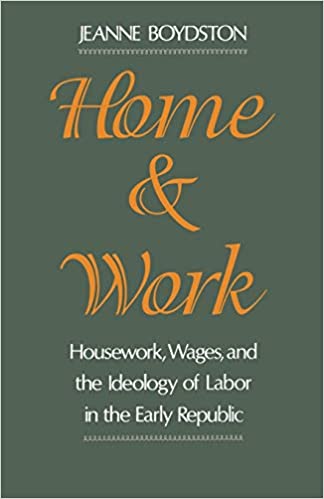
In 1990, Jeanne Boydston examined the intersection of class and gender in the now somewhat defunct “sphere” of private domestic life. In the early colonial period, women’s production and reproduction—work—was acknowledged and valued as contributing to the family economy. By the end of the seventeenth century, the rise of commercialism began to limit the definition of production as both masculine and performed outside the home, which shifted women’s domestic work outside the sphere of labor and production. As labor became accountable to capital, housework became accountable to paid labor—male workers.
Though this shift began in the mid-1600s and accelerated in the 1740s, in the Revolutionary period there was a temporary halt, as women’s work was held up as patriotic and crucial to the war effort, especially making fabrics, clothes and blankets for the war effort, as well as using American made goods and boycotting British goods, as we saw in Kerber’s Women of the Republic. But this quickly shifted back to the diminishment of women’s work, as citizenship was not defined by productivity but by economic citizenship. The republicans of the era feared a government by the people and “a commitment to the commonweal, industriousness, virtue, and a love of equality” (38) were crucial, but most important was economic standing so that the citizen would “ not be susceptible either to bribery, to threats, or to promises of wealth.” As such, women were written out of this economy, as their domestic productivity was ignored by the larger economy and, subject to coverture, they could not own property.
Further, republican motherhood was valued whereas housework, more time consuming and grueling, was not. Women, nevertheless, sold home manufactures, food, home sewing, scavenged goods, and also took in boarders. Still, the home was idealized as a safe refuge from the hubbub of technical modernization and the marketplace. Women were expected to be useful home economists but were treated, at the same time, as if decorative and useless. Their work was simply a manifestation of love and comfort rather than valuable labor and goods. This occurred as wage labor began to define men’s lives in the early Republic.
Boydston argues, following Marx, that the exchange value of work or goods are not dependent on their usefulness, but on market relations and status (28). Though housework was and is essential to capitalist production, its value was canceled in the developing relations of power in the market economy, which placed housework in the service of laborers and laborers in the service of capital. Women were denied the value of their work.
Yet, Boydston demonstrates that the home was a “mixed economy” where women’s labor filled gaps between cash income and necessity. She estimates the value of women’s domestic work based on class. Working class women’s housework she values $250-500 above her personal cost and assured the survival of the family. Middle class housewives she values at over $700 and added to security and status. Women’s work was simply about being women than completing valued labor, which devalued women in society. No longer subservient but valued as in the colonial era, women’s work was both subservient and “pastoralized” in the industrializing eighteenth century.
CATEGORIES: Cultural and Social History, Early U.S. History, Colonial U.S., Women’s History, Gender History, American Revolution, Sex History, Philadelphia, Pennsylvania History, Sex roles, Social Marginality, Race, Sex, Class.
PLACE: Philadelphia, Pennsylvania
TIME PERIOD: 1730-1830
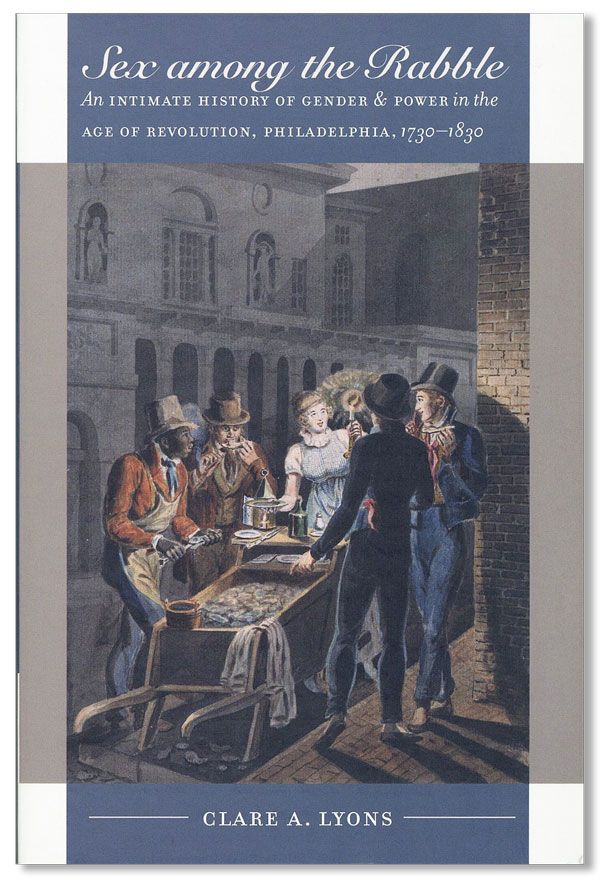
TAKEAWAY: Clare Lyons breaks the myth of a proper, Quaker early Philadelphia and argues that in the mid-eighteenth century, diverse women and men created a pleasure-seeking culture in which women could explore the ideas of Enlightenment autonomy. After the Revolution, this culture was replaced with the familiar, Victorian norm of proper, asexual women and ravenous, virile men. To demonstrate her argument, she examines self-divorce ads, birth rate, court records, and the popular press.
SUMMARY:
To come! This is a fantastic book and highly recommended book, so I want to spend some time with the summary.
CATEGORIES: Cultural and Social History, Early U.S. History, Print Culture, 18th and 19th Century U.S. history, Publishing History, Press and Politics, Book Industries, Book Trade, and Reading, American Studies.
PLACE: United States
TIME PERIOD: 1770-1870, especially 1770-1800 and 1830-1850.
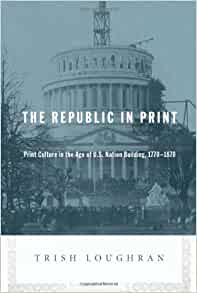
SUMMARY: Trish Loughran interrogates the much-loved belief that the identity of an Andersonian American “imagined community” was formed in the late-eighteenth century. Because print distribution was localized and fragmented rather than simultaneous and national, no national vision of America was shared in print or public space. This is contra most historians, including Breen. She argues that Paine’s “Common Sense” and “The Federalist Papers” were not actually widely circulated. Rather, locally printed and read materials were.
The Revolution and the ratification of the Constitution actually depended on this fragmented public sphere and print network. If one existed, Loughran posits, it would have better resisted a Federal state.
By the 1830s, when the national infrastructures came to be and print became nationally distributed, the nation fractured rather than rallying together in imagined community. Regionalism and local loyalties that were forced into public national discourse ignited the Civil War.
Loughran uses material culture studies to examine various cultural items as she traces the movement from the theory of a nation-state, the Constitution, to the actual institutions of nation-state. Using the campaigns of the national abolitionist organization, the American Anti-Slavery Society’s (AASS), she argues that mass distribution of print revealed how deeply region the young nation was, which acted to split the US apart.
CATEGORIES: Cultural and Social History, Early U.S. History, Colonial U.S., Capitalism, American Revolution, 18th-century Economic History, Material Culture, Marketplace Revolution
PLACE: Early United States
TIME PERIOD: 1740-1774
TAKEAWAY: The consumer revolution of mid-17th century American formed a common cause amongst the diverse and geographically dispersed US colonists as they came together in a trusting “imagined community” (per Benedict Anderson) to revolt against the British Empire.
SUMMARY:
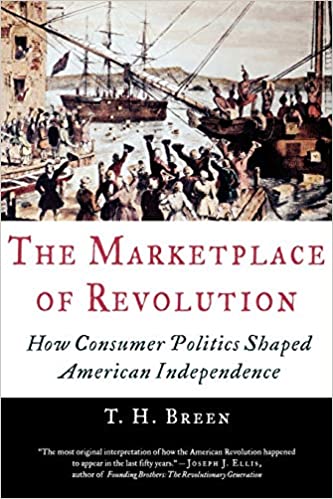
T.H. Breen extensively documents the material culture of the American colonies in the decades before the Revolution to argue that the new consumer marketplace created an imagined community of consumers who rebelled against the English. The unjust taxes that the Crown imposed, in the 1760s and 1770s, on the colonists’ new and beloved consumer goods cause rebellions that came to define them as political individuals. Rather than Bailyn’s ideological revolution, Breen offers a movement based on the marketplace, the common man and quotidian life. The book “explores how a very large number of ordinary Americans came to the striking conclusion that it was preferable to risk their lives and property against a powerful British armed force than to endure further political oppression.”
Breen answers this oft-explored question by arguing that it was through a new language of shared consumer experience. People of different classes and genders developed radical methods of resistance, particularly through the boycott. They would suffer together the deprivation of English manufactures, sacrificing for the common cause of revolution. Similar groups in different colonies found common ground and transformed politics and society through the popular press and collective imagination.
PART ONE: AN EMPIRE OF GOODS
The American colonies, by 1750, had become an “empire of goods.” From Georgia to Maine, “even the most humble” Americans bought similar consumer items which connected them in an imagined community. They discovered a shared experience in personal choice, which Breen believes did not exist before the marketplace revolution.
PART TWO: A COMMERCIAL PLAN OF POLITICAL SALVATION
Breen dismisses Christian virtue and republican virtue for liberal consumer virtue, or “bourgeois virtue.” “When ‘A Farmer’ praised the ‘honest man,’ he had in mind a person able to exercise self-restraint when tempted by a brilliant array of imported British goods” in the consumer marketplace. It was someone with honor and character who would deny himself “private pleasures” for the public good. Too much personal debt was a danger to the common good, and this concerned the virtuous man. This bourgeois virtue did not require one hold property (at least not much) or title—only that she or he could buy goods, something literally any free person could do.
This shared experience gave them the resources to develop resistance grounded in the marketplace—particularly the boycott. Breen argues that American colonists were the first to organize mass political boycotts, just visited in Linda Kerber’s Women of the Republic. If we recall John K. Thornton, American Indians used trading boycotts against the English, and Jill Lepore discussed the abolitionist Quaker Benjamin Lay’s political refusal of slave-made goods in These Truths. However, Breen argues that private consumption was transformed into intentional public and communitarian acts of resistance after the Stamp and Townshend Acts. The latter taxed indirectly English commodities like tea, paper, lead, glass, and paint. The boycotts that followed allowed ordinary people a voice in politics never before experienced.
Those who consumed the boycotted goods were suspect, and people learned trust in their follow colonist near and far, sometimes disappointed, but always persevering. By the books close before the Revolution in 1774, this trust and community extended to shared liberties and rights of the common man. Thus, this was the first revolution “in recorded history to organize itself around the relation of ordinary people to manufactured consumer goods.” Breen believes that this resistance in the consumer marketplace was in fact a revolutionary politics of “pursuing happiness.” In Breen’s telling, stuff is the basis of American liberty, after all.
CATEGORIES: Cultural and Social History, Early U.S. History, Women’s History, American Revolution, Political History, Intellectual History, American Ideology, Property, Education, Coverture, Republican Motherhood
PLACE: Early United States
TIME PERIOD: 1768 to 1810
TAKEAWAY: Middle- and upper-class white women participated actively in the Revolutionary War and found their rights curtailed by the Revolution, contra to the ideology of the war. In response, they developed the “Republican Mother,” an active patriot who encouraged patriotism in her husband and children, especially sons. This allowed them a limited political role for which they must be educated. Women could maintain their private lives while still playing a role in the civic virtue of the republic.
SUMMARY:
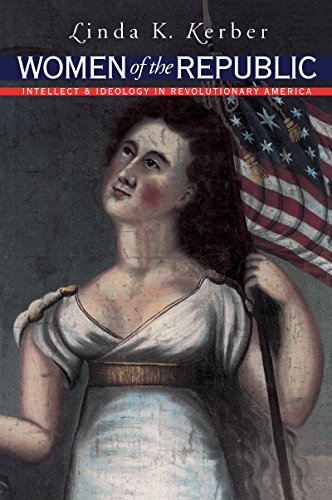
While the ideology of freedom and natural rights was central to the American Revolution, Kerber argues in this 1980 classic, that these rights were restricted to men, and that the Revolution was conservative for white women, who saw rights curtailed.
Kerber offers an interesting and quick overview of Enlightenment thinkers on women in chapter one, “EMPIRE OF COMPLACENCY”: The Inheritance of the Enlightenment.” Civic virtue and patriotism were masculine. Women’s qualities, particularly “Luxury, effeminacy, and vice”” were to be avoided. Effeminacy meant timidity, luxury, and self-indulgence, qualities that threatened America’s new liberty.
During the war, however, women had participated fully as makers of American-spun clothing and blankets, boycotters of tea, grapes, and lettuce, political petitioners, policers of hoarding local merchants, home economists, cooks and carers of troops, nurses, and landlords of boarding houses who took in troops and prisoners. Their contributions were little recognized and ended abruptly after the war. These experiences were new for women, and faced with new ideologies of freedom and autonomy, they began to question why their old positions in society had not changed with the new ideology.
During the war, dowers and coverture laws came into sharp focus when women were expected to declare their loyalty to the Revolution instead of following loyalist husbands into exile. Women had to choose between their property and their husbands. Many were horrified by this prospect, and even revolutionaries usually preferred wives remain loyal to their husbands over loyalty to the Revolution.
Coverture continued after the Revolution and, contrary to Mary Beard, equity laws did not make up for the problems of coverture. Equity “eroded slowly and erratically” in the first fifty years of the United States and women’s property legislation was not a trend until the 1850s. After the Revolution, women’s property rights became more complex and access to equity courts was less common, and divorce was difficult to obtain, especially for women. Because American virtue and political participation was based on land ownership, women were fundamentally excluded. Kerber calls women’s lack of political rights an “accidental remnant of feudalism.” Demands for women’s property rights soon shifted into a demand for women’s access to republicanism.
Women’s education was the most successful aspect of “Republican Motherhood.” Educated women had been suspect and mocked, but after the Revolution, women pushed for their own education in the name of educating their sons. Women’s intellectual capacities were not challenged. Instead, reformers argued that a politically independent nation required literate women uninterested in fashion. Though she had no agency in politics, she was responsible for it through her mothering.
Dependent on her husband for income and political representation, she learned in the “service” of her family rather than for her own edification or use. Women did not push against the confined role of women in the home. Instead, they lifted her role to that of virtuous and educated mother.
The Ideological Origins of the American Revolution
CATEGORIES: Intellectual history, Political history, Constitution, Early U.S. History, Colonial U.S., democracy, U.S. Government., American Revolution
PLACE: American Colonies and England
TIME PERIOD: 1640-1800.
TAKEAWAY: “Study of the pamphlets confirmed my rather old- fashioned view that the American Revolution was above all else an ideological, constitutional, political struggle and not primarily a controversy between social groups undertaken to force changes in the organization of the society or the economy [contra Charles A. Beard].”
SUMMARY:
While Bernard Bailyn has received plenty of criticism for being a relic of his time, few academic history books stand up to half a century of discussion. The book is, first and foremost, an intellectual history, which very clearly defines its parameters in the 17th and 18th American centuries to that of privileged white men. Bailyn was a legendary historian, and one of the first to plug data into a computer to retrieve historical insights. It is interesting, clearly written, and won both the Pulitzer and Bancroft.
Bailyn examined the pamphlet literature, which best expressed the forming thoughts of the era, of revolutionary writers to understand the ideas behind the revolution. These privileged white men were not philosophers or literary writers (in fact, often the writing was quite rudimentary), nor were they removed from the realities of daily American life. They were merchants, plantation owners, lawyers, politicians, and preachers who were interested in keeping and expanding their power, which the flexible forms of government in the early American colonies had permitted them the 17th century, particularly when the English Crown began to crack down and limit these liberties in the 18th century, largely for the profit of the motherland.
Should be working but…snow day needs.
As they considered and, importantly, used, the ideas they had inherited from Greek antiquity, English common law, the Enlightenment philosophers, Puritan covenant theologians, and crucially for Bailyn, the English commonwealth thinkers, the “country men” and radical Whigs who challenged the monarchy in the 17th century English Civil War. The writers of Cato’s Letters, John Trenchard and Thomas Gordon, were particularly admired and quoted.
These pamphlet-writing merchants, lawyers, and other landed men, alarmed by corruption in English and political dangers in the colonies, concluded that they must “destroy” the political and constitutional system that governed them and create something new. This new state would recapture their progressive ideals and the “public life of separate states” with “no claims to the powers of nation-states. Finally, they would create a federal government that would rule over the states only in the crisis of war. The process of creating this nation-state threatened their ideological revolution, which forced them to rethink the original principles that led them to victory, modernize and refine them, and reapply them to their federal state. “In the end they found themselves fulfilling their original goals by creating power, on new principles, not by destroying it” through “natural endowments of humanity based on the principles of reason and justice.” While the ideology of the revolution and constitution were abundant in England and elsewhere, the way these men put the ideas into action was distinctly American. America’s special place in the eyes of God was a part of this ideology.
The disposition of power was central to the colonists’ political theory, which John Adams described as dominion. “Power to them meant the dominion of some men over others, the human control of human life: ultimately force, compulsion.” Those who held it had a tendency to push past “legitimate boundaries” and tread on power’s “natural prey, its necessary victim…liberty, or law, or right.” Power is on one side, liberty and rights on the other. Power is “brutal, ceaselessly active, and heedless” while liberty and rights are “delicate, passive, and sensitive.” How fascinating that these qualities are associated with the masculine and feminine. Hence Lady Liberty?
Power was not essentially evil but natural and necessary. If its foundations were “in compact and mutual consent” with restrictions that virtuous men understand and accept as necessary to the public good, this allows society to grow “from a state of nature and create government to serve as trustee and custodian.” What made power problematic was not the nature of power but of man. “his susceptibility to corruption and his lust for self-aggrandizement.” To contain the power of men in government, the people must have checks on their power through a constitution of government systematized for the good of the whole community. As such, the vigilance and morals of the people were utmost. Industrious, Protestant and Saxon people were ideal for this task. While these concepts were English in origin, the English at home had fallen under the sway of corruption and had forgotten their ideals since the English Civil War, when the English standing army turned against their own.
The English system of checks and balances, the separation of government, became problematic: “If, particularly, the agencies of power— the prerogative, administration—managed, by corrupt practices, to insinuate their will into the assembly of the commons and to manipulate it at pleasure, liberty would be endangered.” These issues intensified for the colonists after 1763 when English raised taxes to pay for the Seven Years War (French and Indian War). Taxation without representation and the arrival of an English standing army in Boston to enforce the unjust taxation increased the alarm of the pamphleteers, who spun these actions, their hatred of corruption, and yearning for liberty into fears of various conspiracies by the English.
After the Revolution the (elite) phampleteers discovered that idealism in practice could be dangerous, as in slavery and religion, two institutions that challenge these notions of liberty. So was “democracy,” as clearly commoners could not be considered virtuous or capable of understanding the common good (according to Bailyn). As such, “stability” (or status quo) won over democracy. These issues were debated by the pamphleteers.
Through his reading of pamphlets, which had previously been viewed by historians as propaganda, Bailyn wove a groundbreaking thesis of ideological revolution in America. He broke with the prevailing theories of social and economic causes to argue for an intellectual reading of the U.S. Revolution.
HISTORIOGRAPHY:
Arendt, Hannah. On Revolution. New York: Penguin Books, 1963.
PLACE: Virginia, Maryland, North Carolina, New York.
TIME PERIOD: 1675-1725.
SUMMARY:
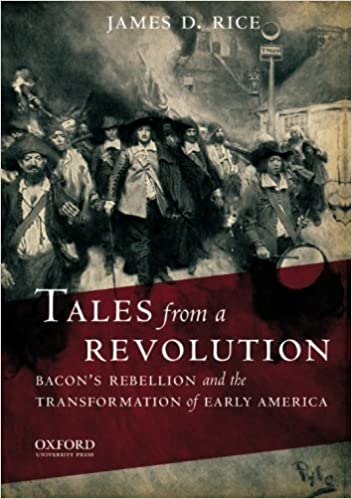
James D. Rice’s short revisionist narrative of Bacon’s Rebellion and the following decades provides a new but familiar thesis—he is unable to support, particularly in such a short book. The synthesis history of the rebellion itself is an enjoyable read, as is the aim of the “New Narratives in American History” series from Oxford University Press, but the entire second part of the book concerns an argument about anti-Catholic conspiracy, which seems strange to a colony known for its irreligion. While Rice builds on Morgan’s American Slavery, American Freedom, he omits pivotal facts from Morgan’s thesis to ultimately argue that were it not for those poor, racist white populists, Native Americans would be thriving in the United States today.
Rice explains in the Afterward that his narrative style precludes a traditional academic thesis, but has allowed him to write in a way that readers must think for themselves about events in order to discover the truth of his thesis, which he spells out at the end of the book. I recommend reading this at the beginning.
The Afterward begins with a valuable historiography that explains the various turns the narrative of Bacon’s Rebellion has taken, before a segue to the benefits and pitfalls of narrative history. Next he hits on a sub thesis, closely related to his main argument, which echoes loudly in 2022. Reliable information was hard to come by for 17th-century Virginians, who “made their choices in the absence of information, operating within what is often called the “fog of war—which, as the great Prussian military theorist Carl von Clausewitz described it, “gives to things exaggerated dimensions and an unnatural appearance.” The unreliable stories of Sarah Grendon, Thomas Mathew, and Nathaniel Bacon indicate that “gossip, rumor, misinformation, and contending stories,” the “wild, irrational tales, full of paranoia, supernatural forces, superheated rhetoric, and outright misinformation” ruled the day (209). It’s telling that Rice does not include Berkeley in his list of unreliable narrators, for, while he concedes that Berkeley was corrupt and had little concern for the frontiersmen whose lives buffered the wealthy planters from the Indians, he believes that Berkeley was in the right. The belief in the supernatural was (and arguably still is, outside of academia, in all social classes) commonplace in this era was well established by historians such as David D. Hall.
The rebellion was caused by the settlers’ “fear, anger, and suspicious-mindedness; their paranoia and susceptibility to conspiracy theories; their vengefulness and malice; and their willingness to resort to violence, savagery, oppression, and cruelty when they felt threatened by Indians, governors, “Papists,” or anyone else outside their tribe.” Ah yes, those poor, tribal whites. Never mind the violence, savagery, oppression, and cruelty of the governors and the assemblies in their never-ending pursuit of profits. Never mind that poor, white indentured servants rebelled side-by-side with Black slaves. And never mind that the poor whites forced to the edges of the frontier by elites were frequently victims of Indians “violence, savagery, and cruelty” when the wealthy ruling class pushed them off their land.
To believe Rice’s argument requires forgetting, or ignoring, that Berkeley, long-known as an diplomat par excellence to his Indian trading allies, thirty years previous had forced the Powhatans off their land around Jamestown, killed their chief, and almost obliterated the tribe of over 10,000, by far the largest of the area. After subduing the tribe he engaged them in fur, skins, and Indian slave trade. Confusing a wish to protect his financial interests with a special concern for Indian rights is dubious and buys into a “good Indian, bad Indian” narrative (see Thornton). What his and other texts demonstrate is that white English elites used Indians when it served them and turned on them when it did not. That we are to believe that wealthy colonists did not take lands from the Indians when it suited them and when they could, that instead it was the fault of the “savage, superstitious, tribal” poor white populists is quite a fantastic thesis. But it does serve a certain political position and psychological viewpoint—that racism is the fault of racist, “tribal,” poor whites over there, rather than baked into the systems and psychology of the United States. As Morgan suggested, racism serves elites today as well as it did in 1676.
More welcome in Rice’s analysis is his inclusion of Indians’ experiences during this period. He details how English gentlemen pushed Indians westward and southward, as did the powerful Five Nations Iroquois of the mid-Atlantic region. Tribes that migrated had to negotiate with tribes already inhabiting those areas, who often used different languages. These negotiations often turned into wars, and larger tribes subsumed others as more and more Indians were dislocated.
In Part Two of the book, Rice argues that Bacon’s rebellion was not a short period of insurrection led by the notorious Bacon. Instead it was a series of rebellions caused by various political alliances and the displacement of Indians. In Rice’s telling, Bacon’s Rebellion was not against corrupt royal authority but against authority that would not remove frontier Indians’ from their lands. Rice suggests this is because of white tribal racism, ignoring the facts that the elites intentionally restricted freed servants’ access to land to decrease their power and increase the value of the elites’ land. Nor did the government seek to protect the poor whites on the frontiers who were often killed by Indians seeking revenge on actions taken by government officials. We are not asked to consider why, exactly, poor men brought, often by force, to settle and work in servitude in a faraway land with shocking morbidity rates, might be angry.
Instead we are told that the Baconites were summoned by a tract called “A Complaint from Heaven with a Huy and crye and a petition out of Virginia and Maryland ” written anonymously late in 1676, before the rebellion had been squashed. It called for a continuation of the rebellion due to Lord Baltimore’s mistreatment of his people through his alliances with Indians. He was against the people because he was a papist Catholic in alliance with Indians and the French in Canada, who were drawing closer and closer to Virginia. Bacon’s Rebellion, Rice argues, was not against royal authority but against Catholicism and the threat of Louis XIV. They continued to rebell in the 1680s and followed closely the Glorious Revolution, believing a Protestant king would serve their interests. Indeed, when William III claimed the throne in 1889 he placed Francis Nicholson as royal governor. Nicholson allegedly followed the desires of the Baconites and henceforth used broadstroke anti-Indian policies. It was not because trade with Indians for skins and Indian captives was, by the 1690s, no longer enticing for the elites, but because of the desires of the racist rabble.
The connections between Bacon’s Rebellion, the Glorious Revolution, and Coode’s Rebellion are unclear. Though Rice elaborates in his afterward, there is simply not enough evidence presented to make the connections believable. While his independent analyses carry weight, that they are all bound up together is problematic. While he asks at the end, “What if Bacon had died young?,” suggesting that perhaps Indians would have prospered under more Berkeleys and Baltimores, I was instead convinced that given the numerous uprisings before and after Bacon, and the elites’ need to control the exploited poor, and the shifts in Indian economies, these trends would have developed with or without that particular sorry rebel.
CATEGORIES: Early American History, European History, Colonial History, Race History, Labor History, Slave history, Slavery, Indentured servitude, Poverty, 17th-century Virginia, Economic inequality, Social history
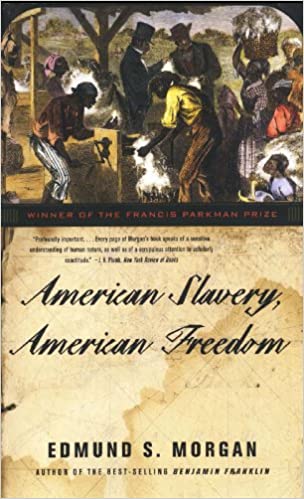
Edmund Morgan takes on a quintessential anxiety of many American historians: How could the founders of the great and free democratic American republic have endorsed, and indeed owned, slaves? Morgan believes that freedom and equality depended on slavery, not incidental to it, in a story of great English hopes gone wrong. This book is also a history of early Virginia, the colony that the slave-owning writers of the Declaration of Independence and Constitution called home.
Morgan begins with the piracy of Sir Walter Raleigh and Sir Francis Drake in the Americas. When Raleigh sponsored the first settlement in North America at Roanoke, he dreamed of liberating Africans and Indians from their cruel, Spanish-Catholic enslavers and founding a biracial society in the New World. This would be accomplished because the North American Indians would be eager to adopt the ways of the “civilized” English and happily work for them and adopt their Protestant ways and “gentle government.”
The problem of labor is central to Morgan’s history. This is a story of English merchant elites’ speculating in the New World. Who would do the tremendous labor involved in founding and developing a new colony? It would not be the elites, who sought to extract as much profit from the settlement as possible. At Raleigh’s Roanoke, the labor would be performed by willing, grateful, and free workers. When this colony died, so did this dream. The English at Jamestown were not as idealistic.
Chapter 2: The Lost Colony
Raleigh and Haklyut, an English priest and writer, convinced Queen Elizabeth that an English settlement in North America would be a crucial base from which to stop and potentially overthrow Spanish rule, but it could also be a place for England’s numerous and problematic poor. England had more people than jobs and the solution to poverty was “to find more jobs, whether in England or in America.” A good friend to Raleigh, by 1585, the queen backed his new colony, supported by pirate raids by Drake in the Caribbean. John White settled the colony, as the queen would not allow Raleigh to leave her council in England.
The problem with Roanoke was that neither the elites nor the first settlers planted the food they would need to sustain them through winters. Morgan argues that most of the settlers were warriors and elites who were not interested in the mundane work of planting food. They either bought or took it from Indians, who ran low on supplies in winter as they did not grow in excess of their own needs, or relied on shipments from England. Although it became clear that without their own crops the settlers would starve, they preferred cannibalism to work. This issue replicated itself in Jamestown twenty-two years later.
Chapter 3: Idle Indian and Lazy Englishman
Richard Haklyut, merchant Sir Thomas Smith, and others received a charter from King James I in 1606, which created the joint-stock Virginia Company of London. Since Roanoke, England had made peace with Spain and James I would not permit piracy against Spanish ships. Investors then hoped to find precious minerals, metals, plants, and a northwest corridor to the Pacific—or simply whatever they might grow there—as well as some rogue piracy. In order to harvest such wealth, poor Englisment would be sent to work as indentured servants for seven years to pay off their transit across the sea and following this reap the rewards of the new world. Unfortunately, most of them died.
The Virginia Company had a beneficent attitude toward the Indians, believing they work for them and learn their ways. It was not simply formed for profit, like other joint-stock companies. It was established for the “higher nature” of a patriotic business that would civilize the savages and cure the masses of England of sinful idleness and crime. The speculators lost their capital and most settlers lost their lives, as did most of the Native Americans of the region.
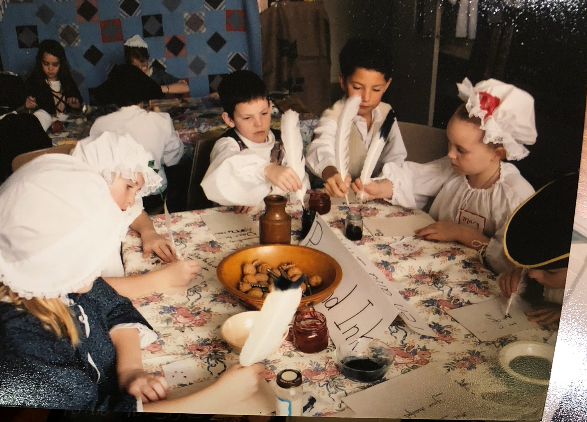
American Education, Virginia, 2000
The English did not comprehend that the Indians valued their way of life, as most people do. Morgan argues that “The Indian way of life was of the kind that still generates, among those who practice it, a minimum of worldly goods and a maximum of leisure time.” They farmed only what they needed by rotating crops on land for 5-10 years and leaving it fallow from 30-40. While developed countries long thought of this as wasteful and backward, it has been shown that this system can produce more food per hour of labor than any other. They cleared forests for hunting that opened them and allowed for game, nuts, berries, fruits, and flowers unknown in the dense second-growth pine forests of Virginia today. Such hunting, gathering, and long-fallow farming societies require about two to six hours a day of work, far less than that of people in industrial societies. English gentlemen were far above labor. Everyone else was expected to work from before dawn until after dusk with such little pay they could not sustain themselves.
Those sent to develop Jamestown were a collection of English gentlemen who were above work and the poor who allegedly avoided it. “The Virginia Company had sent the idle to teach the idle” who sought to give “freedom to the free.”
Chapter 4: The Jamestown Fiasco
Morgan reviews the first ten years of the Jamestown settlement to explore why the colonists did not grow food for themselves and learn to prosper in the new land. The English were “unwilling or unable to feed themselves” and forever altered their good relationship with the Indians by bullying them for corn—or outright stealing or destroying it, as well as the Indians themselves. This was largely due to the terrible organization and direction of the settlement.
John Smith did not agree with the company’s policy of kindness toward “savages” and he was responsible for demanding corn from them. He believed slavery, or something close to it, was the best use of the Native Americans. In a change of heart from the Company, he was told to defeat the area’s tribes and make them pay tributes. Meanwhile, the Company sent various skilled servants for unneeded positions like iron ore workers and blacksmiths, or the “idle, criminal poor” who refused to work. These were not men who knew how to live off of the land, particularly in a new climate. They did not think that food would be a problem.
Their failure to grow food for themselves humiliated them as they relied on the Indians whom they regarded as savages yet were able to outperform them agriculturally.
After ten years, what shifted their fortunes was the tobacco that Indians smoked and grew. The English soon tried seeds from the West Indies and suddenly the idle became industrious as they planted tobacco, seeking profit.
A Previous Reader’s Comment
Chapter 5: The Persistent Vision
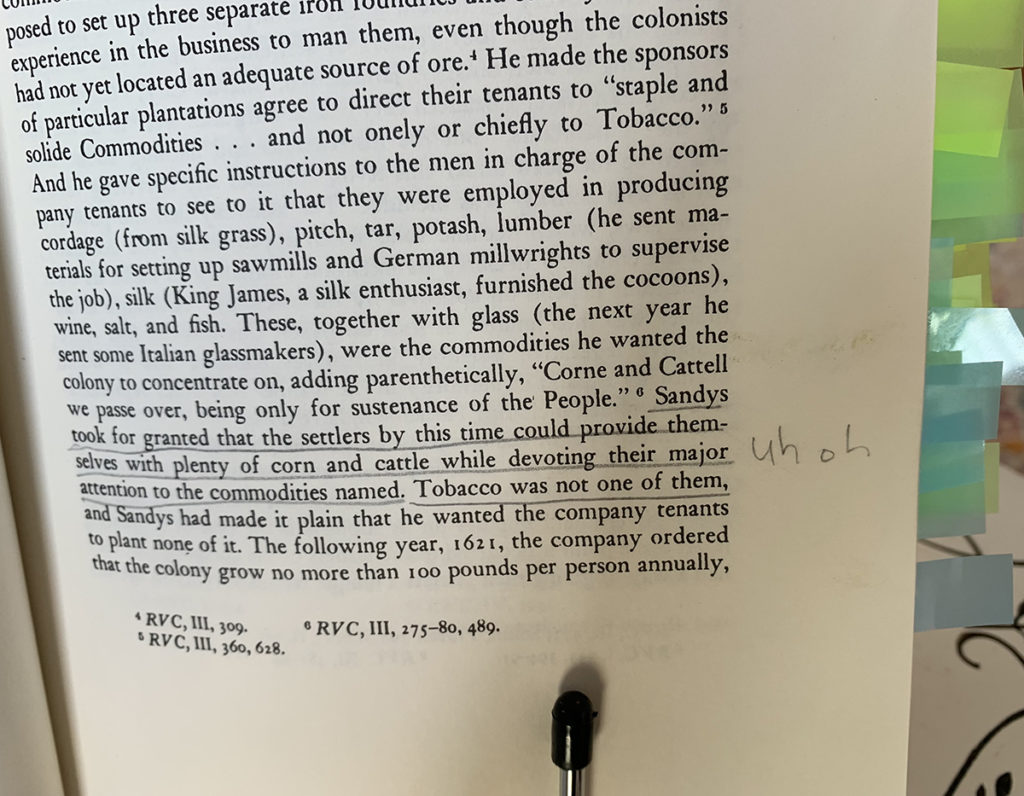
This chapter focuses on a shift in The Virginia Company program from militarization to increased benefits, namely land, for settlers. The company and the English government wanted the colony to produce crops more beneficial to society than tobacco, however no matter the plans back in England, tobacco was the crop of choice for it brought profit. Thousands of servants died in these years and relations with Native Americans further declined. Ultimately, The Virginia Company failed.
Chapter 6: Boom
The tobacco boom of the 1620s enriched planters, who were willing to work harder than they ever had, and make their indentured servants work even more. Morgan emphasizes a major part of his thesis—because most servants (more than half) did not live past their period of servitude and were thus not alive to receive the promised goods at the end, bringing multitudes of poor servants to Virginia and forcing their work was extremely profitable for planters. It was more profitable than slavery, in fact, because slaves cost twice and much and would likely die just as soon.
Though The Virginia Company suffered massive losses in London, many planters in Virginia were getting rich off of illicit means. They lied to their superiors in London and exploited their workers to the point that while they were not slaves, they were not free. And most would not live to see freedom.
The governor and his council, filled with the richest men with the most servants, held the power in Virginia. These men were able to control the government and as such all men of lower social rank, including freed servants. Their policies protected themselves and harmed others to lengths that Morgan considers likely unconstitutional. “Masters bent on profit ‘corrected’ their laggard, hungry, and diseased servants with barbarous punishments,” and to a further extent than in England. Courts usually sided with masters and Morgan sees this boom period as a time in which planters viewed their workers as machines for production, things rather than humans.
BOOK TWO: A NEW DEAL
Chapter 7: Settling Down
Though Barbados planters turned to slavery in the 1620s, Virginians did not in any scale, largely because their tobacco was not as profitable as sugar and they could not afford them, particularly when most servants or slaves died in the first year of American life. The Virginia elites beat, sold, and bought their servants to an extent that shocked other Englishmen, but did not enslave them “as we understand the term.” When the tobacco boom ended as the price of tobacco fell, the elites shifted their attention for the next three decades, to settling the land. Most Virginians had fewer rights than those in England and Morgan argues this period saw a focus on building a civil society.
The get-rich-quick tobacco scheme period ended and the decades of attention to corn production, though small, and the introduction of pasture farming, were finally supporting the colony. As life became more sustainable, colonists began to view Virginia as home rather than a stopping place. The elites began to focus on laws that would restrict the power of England—to them, freedom meant little oversight from the motherland. They set up counties, county courts, and county parishes, though they were much less religious than New Englanders.
The number of Blacks in this period was low, no more than 500 by 1650. They arrived as slaves, but some became free. Others were servants. All enjoyed more rights than they would when slavery became common. They were not treated more brutally than servants and some were able to earn money and buy cattle, or even their freedom. There are records of slaves being sold only with their consent. In short, 17th-century slaves had for more rights than later slaves would. Morgan argues that while racism affected Blacks, there is ample evidence that they were seen as capable members of the community subject to the same laws and rights of other non-elites.
While Virginia was built on English laws and customs, centered on pasture raising and exploitation of labor, it was quite different.
Chapter 8: Living with Death
The survival rate for newcomers to Virginia was less than half, largely due to Typhoid, which killed people in summer. This affected early Virginia society in that there were many doctors and quack doctors, though the difference between the two was unclear. They charged exorbitant rates and would bind free men as servants if they couldn’t pay. Women were scarce and usually widowed several times. They had greater economic advantages than in England, inheriting one-third of her husband’s estate which resulted in men marrying far older women instead of her daughters. Because land was plentiful it was not valuable. Cattle and servants were, the latter being more risky, and tobacco served as currency, often payable in the next yield. This created a unique system of credit and exchange.
Morgan pins the stabilization of life expectancy to population growth in 1644.
Chapter 9: The Trouble with Tobacco
New England achieved a much more balanced economy than could one governed by Virginia’s tobacco-dependent elites. Corruption was rife and the increased taxes imposed on tobacco by the King after the 1650s caused a struggle between the King and English merchants, on one side, and Virginia’s planters on the other. They all sought to press as much profit out of small planters and servants, who would pay far more to the king than he would keep in profit. The 1620s boom period was the worst for exploitation, but it did not end afterward, as elites built governing structures to exact as much profit out of the servants and small (often freed) planters as they could.
Chapter 10: A Golden Fleecing
After 1660, the King of England profited most from Virigina’s tobacco trade. He ended Virginia’s trade with the Dutch which cut the colony’s profits. Large planters, in turn, exploited the men who did the work of growing tobacco even more through the force of Virginia’s government. Meetings of the Virginia assembly, where corruption was rife, cost the lower class taxpayers dearly. Though survival of the servants increased, due to government laws that favored the rich, it became far harder to succeed in Virginia unless you were already wealthy.
PART THREE: THE VOLATILE SOCIETY
Chapter 11: The Losers
Virginia in its beginnings was structured around the intense loss of life of the people. As life expectancy rose, more servants became free, and these free farmers were a problem for the rich. If they kept growing tobacco on their own, they competed with their former masters and depressed the price. If they became idle they would become destructive to society. Either way, they posed a problem to the profits of the elites. So the government changed laws and society to limit the independence of freemen and further harm the servant. From the 1660s onward, tobacco enriched the king and his elites, the workers were “losers, and they did not much like it.”
Servants’ terms were extended and greater punishments were served for running away. Servants who gave birth or stole hogs (how runaways survived) had terms extended. Land in the safer, colonized areas was running out and owned by only a few, over 100,000 acres held by thirty men. Freedmen now had to pay rents or work for former masters. Those who did manage land had to pay larger planters to market and trade their crops. As the death rate fell, Virginia’s elite pressed freemen out of profit and “reduced the rights of those on whose labors they depended.”
Chapter 12: Discontent
Virginians were easily exploited “partly because they were selected for that purpose: they were brought to the colony in order to be exploited.” Englishmen, by which Morgan means “gentlemen,” thought of their colonies as a place they could make productive the “useless wretches” men of overpopulated England. Of course, they viewed this as charity and morally uplifting to their victims. They chose young men as most able bodied, and women were vastly outnumbered in Virginia. Their exploitability, however, could make them reckless when freed. The assembly decided in 1670 not to allow them to vote and used their power to submit the men in any way possible. Still, they often worried about revolt.
Chapter 13: Rebellion
Nathanial Bacon, a young newcomer with friends and family well-placed in Virginia society, was placed on the council by Governor Berkeley. A well-born Englishman, he did not like the nouveau riche of Virginia’s elite. He did not like Indians, either, though he settled upriver fairly near the frontier. A group of Virginia’s military elite attacked a group of friendly Indians, the Susquahanocks, which caused reciprocal attacks on the English. Bacon used the resulting anger and unrest of the poor frontiersmen to cajole a large group of freed Black and English men to rebel against Berkeley, whom Bacon found to be too generous with politically allied “friendly” Indians.
Thousands of Virginians joined Bacon against Berkeley and marched on Jamestown, forcing Berkeley across the river. Government forces put down the rebellion and Berkeley returned, still refusing to change his policy toward Native Americans. Bacon rallied his followers and killed nearby Occaneechi Indians in an assault.
At the same time, Governor Berkeley acted against the danger of angry freed servants, small landholders, and their Black allies. He called an assembly and changed laws to improve matters for poor freed men and pacify everyone but the Indians. The right to vote was restored for freedmen. Parish church vesteries were no longer co-opted but elected, petty officials could no longer collect fees for work not done, and councilors would now pay levies. These were aimed to stop the corruption of the few against the many. This did not stop the exploitation of servants but it did give a bit more power to the laboring class.
Bacon’s plan was to use the fear and anger of men who lived on the frontier, who were often subject to Indian attacks that Berkeley and his men did not protect them from, to provoke an attack against the ruling class. “The Indians would be the scapegoats. Discontent with upper-class leadership would be vented into racial hatred, in a pattern that statesmen and politicians of a later age would have found familiar.”
Bacon’s men marched from June until September of 1676, when they burned Jamestown to the ground. Bacon died in October, and the rebellion petered out, partly put down by British forces.
Chapter 14: Status Quo
The King made a large profit from Virginia’s workers and when the people he trusted to ensure that they work efficiently failed so miserably, he called a commission to investigate his lowly subjects’ grievances so they would get back to growing his tobacco. They found Berkeley and his friends seizing all the property they could. Just as the King had feared, the Virginian statesmen were abusing the people to the point they would no longer produce. Berkeley ignored his order of removal at first, but finally returned to England.
The King’s advisors struggled with the elite of Virginia over who could extract more from Virginia’s profits, and the concern for the rights of the small planter and laborers fell to the wayside.
BOOK IV: SLAVERY AND FREEDOM
Chapter 15: Toward Slavery
Viriginian elites could not get enough of indentured servants. The problem was how to keep them working for profit not their own. In the second half of the 17th century, they did this by making land scarce artificially (they would push the frontier forward when they wished for more land) which forced freemen back to servitude. As punishment, they extended terms of service. And they punished excessively hog killing, which allowed men to survive without work. They took as much of the “small man’s profits” as they possibly could through rents, taxes, and fees. These burdens forced Virginia into a continual brink of rebellion, and the elites began to seek another way.
“Slavery is a mode of compulsion that has often prevailed where land is abundant, and Virginians had been drifting toward it from the time when they first found something profitable to work at. Servitude in Virginia’s tobacco fields approached closer to slavery than anything known at the time in England. Men served longer, were subjected to more rigorous punishments, were traded about as commodities already in the 1620s” (296). It was not due to moral repulsion that elites did not switch from servants to slaves, but because it was economically advantageous. Until life expectancy stabilized, it was not worth paying for a slave, twice the price of a servant. Planters in Barbados were far wealthier from their sugar crops and could afford slaves, which were cheaper in Barbados because closer to Africa. It was also far more difficult to force servants into the intensive labor required by sugar. Africans were more accustomed to work in the heat and were more brutalized than servants.
By the 1660s, the switch to slavery began. There was a decrease in poor English coming to Virginia because the conditions of labor had become notorious. There was also less pressure to leave England, as overpopulation had subsided. As life expectancy grew, it became more profitable to buy slaves who would now survive long enough to increase owners’ profits. By 1700, half of Virginia’s labor force was enslaved and between 1702 and 1708, almost no white servants had been imported. “The substitution of slaves for servants gradually eased and eventually ended the threat that the freedmen posed: as the annual number of imported servants dropped, so did the number of men turning free.”
Chapter 16: Toward Racism
Morgan describes the English attitude toward their poor in order to contextualize forced labor. The statesmen and economists who wrote on the problem of the poor said that half of the English population “would rather drink than eat and rather starve than work,” the worst of whom were beggars and thieves. “The English poor were “vicious, idle, dissolute,” but as the concept of populations serving to create wealth became popular, the English asked how best to “hold them [the wretches] down and extract the maximum labor from them.” In the 1600s, they founded institutions to force “the sick, the criminal, and the poor” to make them contribute to England’s wealth. Prisons, called workhouses, became a place to extract work from “the criminal, the insane, and the poor alike.” Several English thinkers of the era endorsed enslaving the poor, but the government stopped short of it.
Stereotypes of the English poor tracked with those of African slaves, “even to the extent of intimating the subhumanity of both: the poor were ‘the vile and brutish part of mankind’; the black were ‘a brutish sort of people.’”
Morgan found no evidence that English servants resented working with African slaves rather than white Englishmen. Rather, they seemed to believe they shared the same problems. They often “ran away together, stole hogs together, drank together, and made love together.” During Bacon’s Rebellion, they revolted together.
This chapter supports a central theme of his argument. Before 1660, when Blacks were a minority, it was possibly difficult to tell racism from classism. The solidarity between Blacks and whites was not a problem when Blacks were a small part of the labor force. But Bacon’s rebellion made the elites’ fears of insurrection real, and their response was to codify racism.
Morgan also addresses religion. Before 1660 slaves were thought to be non-Christians, but as the century advanced, they were thought to be Africans. This tracks with Katharine Gerbner’s argument in Christian Slavery.
Through law, they separated “dangerous free whites from dangerous slave blacks by a screen of racial contempt.” The Virginia assembly in 1670 prevented free baptized Blacks and Indians from owning Christian servants. Ten years later it instructed thirty lashes if a slave or Black “lifted up his hand in opposition to any christian” which allowed servants to bully slaves and lifted his status. By 1705, the assembly protected the property of servants and forbid slaves from owning property. In an act that legalized the mutilation of “unruly” slaves, they also determined that servants had sole rights to their property but any cattle or horses that belong to slaves was confiscated by the local parish, which gave the animals to poor whites. The intent was to create animosity between the races and a psychological superiority in poor whites.
Until and even through the 1660s, when more slaves were brought to Virginia, there is little record of “indisputably racist feeling about miscegenation.” There were however laws against Christians having sex with Blacks—similar again to Gerbner’s argument about Protestant supremacy before white supremacy. Morgan gives several examples of interracial marriages before the assembly passed an act in 1691 “for prevention of that abominable mixture and spurious issue which hereafter may increase in this dominion, as well by negroes, mulattoes, and Indians intermarrying with English, or other white women, as by their unlawfull accompanying with one another.” This act punished miscegenation of any kind.
A white person who married an Indian, Black, or mixed person would be banished from Virginia. In 1699 there was a petition to the assembly to repeal this act, which was ignored by the House of Burgesses. They also passed on a request from the justices of a “poor man’s county,” Surry, to tighten the law, indicating that interacial marriage was common there. As not to lose laborers to banishment, in 1705, they changed the law to six months in prison and a fine of ten pounds (about $2,760 in 2022). The presiding minister was fined 10,000 pounds of tobacco.
These acts were far more concerned with the sexual relations between white women and black or mixed men. A free white woman who had a child out of wedlock by a black or mixed father was fined fifteen pounds or sold for a five-year term if she could not pay. Her child would spend 30 years in servitude to the parish. If she was a servant, her term was extended by two years and then sold for another five. The proceeds of her sale were divided between the king, the parish, and the snitch. These laws were directed toward protecting white women, viewed as the rightful property of white men (many had arrived in America because they had been sold as brides). Between 1690 and 1698, about twenty illegitimate mixed children were born in three different counties, even with these penalties. These children threatened the separation of Black and white.
Black women who born mixed children were usually slaves and their children were identified in law as Black slaves to insure that the child would not be free. The 1691 assembly forbid planters to free slaves without transit out of Virginia and later forbade it altogether save a special consideration granted by the council and governor. If an owner did free a slave, the council encouraged the seizure and sale of the freed person. Free blacks in Virginia were denied the right to vote, testify in court, and hold office. Black women were subject to taxation whereas white women were not. In these acts and others the elites intentionally fostered white contempt for Blacks and Indians by intentionally degrading the status of Blacks.
Chapter 17: Toward Populism
As politicians shoved down people of color, they simultaneously started to increase the rights and status of poor and working-class whites, moving them slightly closer to the elites in law. As life expectancy rose, poor freemen grew to problematic numbers. But with the switch to slavery there were fewer and fewer freemen and their financial situations improved.
While poor laws continued in the early 18th century, they were passed shortly after English Parliament allowed courts to send convicted felons to Virginia to serve for seven to fourteen years. Others were sent off to fight the Indians, French, or Spanish in places such as Georgia, Cartagena, and the Ohio Valley. Otherwise, the numbers of free poor men declined and both rich and poor whites grew wealthier, as titheable records and land records in the Tidewater show.
At the same time, lower-class white men also gained political attention. Social and political attitudes changed with the rise of slavery. It began when the King tried unsuccessfully to restrict the powers of the elites after Bacon’s Rebellion. This created a struggle between the crown and Virginia’s governors on one hand and Virginia’s magnates in the assembly. Governors tried to create policies that aided the crown and the small planter by limiting the power of Virginia’s elites. This struggle bore new tactics in the 1690s, when the assembly passed acts that aligned all white men against all men of color. With new voting rights for small land-owning whites, the powerful now aimed to “court their good will.”
This was obvious in 1699, when the assembly forbade candidates to “‘give, present or allow, to any person or persons haveing voice or vote in such election any money, meat, drink or provision, or make any present, gift, reward, or entertainment … in order to procure the vote or votes of such person or persons for his or their election to be a burgess or burgesses.’ It is, of course, no sign of democracy when candidates buy votes, whether with liquor, gold, or promises. But when people’s votes are sought and bought, it is at least a sign that they matter” (358).
Morgan argues that these new politics were not a surrender to the mob but in fact a “new triumph for the men who had dominated Virginia from the beginning.” For those who suspect that American merchants have manipulated the people into believing in freedom and democracy, this argument will resonate. By the 1720s, some policies were designed to reign in Virginia’s elite and to benefit the “small man.” But the Virginia barons accepted none and they did not have to accept them. They were able to convince voters to keep elites in office even with populist politics.
Chapter 18: Toward the Republic
Large and small landowners, with a vast gap in wealth, still had some common interests. Both wished to protect their land and tobacco crops from restrictions and taxation in London. Planters in Virginia were fond of republican thinking, and Morgan argues that poverty was as great a threat to liberty as monarchs and greedy landlords. English hatred and abuse of the “wretched” poor was absorbed, in Virginia, by racism. “Racism made it possible for white Virginians to develop a devotion to the equality that English republicans had declared to be the soul of liberty” whether they had access to that liberty or not. By lumping all people of color into one abused class, they created a binary that on the other end lumped together large and small planters into a favored class.
“Racism became an essential, if unacknowledged, ingredient of the republican ideology that enabled Virginians to lead the nation.” To close, Morgan asks if Viginia was typical of Amercica, and if northerner republicans believed America could become a world power without slavery. They did not. “They allowed Virginians to compose the documents that founded their republic, and they chose Virginians to chart its course for a generation…But were the two more closely linked than his conquerors could admit? Was the vision of a nation of equals flawed at the source by contempt for both the poor and the black? Is America still colonial Virginia writ large? More than a century after Appomattox the questions linger” (387).
CATEGORIES: Atlantic Ocean History, Race History, British History, Christian converts, European History, Religious history, Slavery and the church, Slavery and the church, Slave history, Protestant missions, missionary work and slavery
PLACE: Atlantic World, West Indies (especially Barbados), colonies of continental North America
TIME PERIOD: 1650-1740
SUMMARY:
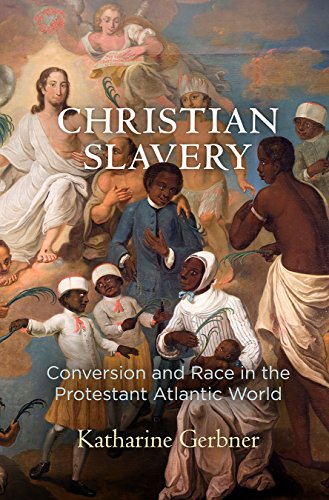
Before white supremacy came “Protestant Supremacy.” In Christian Slavery (2018), Katherine Gerbner offers a revisionist history of Christianity and slavery in the seventeenth-century Atlantic world. She interrogates the historical narrative of Christian missionaries beneficent intentions and anti-slavery views by evaluating journals, letters, court records, and archives in various languages and countries, particularly in the West Indies where such missions first occurred. Protestant missionaries reworked ideas about the acceptibility of Christian slavery when they met planter resistance to slave conversions due to their “Protestant Supremacy.” Slave owners believed that African slaves could not be true Protestants, an ideology that dominated the period (1600-1800) in which Anglican, Moravian, and Quaker planters believed that Protestantism was central to their identity as masters and free men. Gerbner turns the dominant narrative of missionaries’ antislavery beliefs on its head by arguing that planters and missionaries battled over the Protestant Supremacy of the planters and the Christian Slavery of the missionaries. Far from being anti-slavery, Anglican, Quaker, and Moravian missionaries worked to bring slavery in line with Christianity, and they effectively created legislation to this effect. Before Quakers they were abolitionists, they were staunchly proslavery.
Missionaries also provided a rationale for colonization and slavery. The planters argued, partly because by this time it was unacceptable for Christians to own Christian slaves in Europe, that conversion would could cause the slaves to rebel and behave poorly, though there was no evidence to this effect. Slavery was acceptable because the slaves were heathens. Christians had rights; heathens did not. Planters were physically and verbally abusive to missionaries, who, eager to convert slaves and dependent on the planters permission, repositioned their beliefs to promote Christian slavery (which had been debated up to this point). These beliefs were not simply used to persuade planters, but were codified in legislation, which over time created a legal institution of race-based slavery in the West Indes and United States. Rather than creating a foundation for anti-slavery movements, these missionaries created ideologies of paternalism and Christian justification for slavery used in proslavery arguments of the 18th and 19th centuries.
Gerbner also engages the contested concept of “conversion” by noting that Protestant sects had different ideas about what constituted conversion, as well as what it meant to the converted enslaved and free Blacks. Her study is the first to focus on Black slave conversions before the revivals of the 18th and 19th centuries. The baptism of blacks challenged the major justificaiton for slavery in the 17th century—they were not Protestants. This cause a shift of racial terminology that came to justify slavery. The roots of white supremacy are found in “Protestant Supremacy”; the former term is still embedded with religious signification.
Gerbner’s is an impressive account of the missionary responsibility for creating Protestant supremacy, and this is what sets her narrative apart from previous historians who have addressed it. She corrects Frey and Wood’s argument (Come Shouting to Zion, 1998), which ignores the importance of earlier conversions and overstates the importance of the Great Awakening and the “emotive worship” aspect of slave conversion. While the voices of free and enslaved Blacks are faint, this is more likely a fault of the archives than Gerber, who uses some letters and accounts by African American sources.
Chapter 1 Christian Slaves in the Atlantic World
This chapter is a brief review of Christian slavery to the 17th Century and provides a foundation for Gerbner’s argument.
Chapter 2 Protestant Supremacy
Gerbner uses a tract first read in Barbadian Anglican churches in 1662, “The Act for the better ordering of Negroes,” to illustrate the position of Anglican religion in promoting slavery and Protestant Supremacy, countering arguments that Barbadian planters were not religious.
Chapter 3 Quaker Slavery and Slave Rebellion
Quaker leader Geroge Fox encouraged slavery by criticising Anglican planters for not converting their slaves in 1671, which an Anglican minister repeated, causing a larger pressure for converting slaves. Further, Anglicans blamed Quakers for inciting rebellions by bringing Blacks into their meetings and so passed “An Act to prevent the people called Quakers, from bringing Negroes to their Meeting” in 1676.
Chapter 4 From Christian to White
In other places, slaves occasionally won baptism in other plantation colonies, usually “chief slaves” on a plantation, or the slave children of masters, although planters were against largescale conversions, as it threatened their fragile society. This was a very small fraction of slaves—less than 1%. These conversions challenged Protestant Supremacy and planters began to shift the language of mastery to race rather than religion. By 1700, slavery was justified by race, though the ideology of Protestant Supremacy remained. Barbados passed “an Act to keep inviolate, and preserve the Freedom of Elections” which added “white man” to “professing the Christian religion in 1697.
Chapter 5 The Imperial Politics of Slave Conversion
Gerbner uses the example of Christopher Codrington, governor-general of the Leeward Islands, to demonstrate that while planters reconsceived slavery in terms of race they still resisted most slaves from Christian practices as as such, Gerbner argues, shows the maintenance of Protestant whiteness. The transition to white supremacy took decades and slaveholders still required proslavery arguments from missionaries and other religious figures to feel comfortable with slave conversion. Codrington found it difficult to reconcile slavery and his Christianity, though he tried. He tried to convince planters that Christian slave communities were safe and not rebellious, but he also understood that it was a complex moral, political, and imperial matter.
Chapter 6 The SPG and Slavery
Codrinton fought against and then worked with the French, who provided an example of Christian slavery in the continetnal colonies of North America. Influenced by the Catholic colleges, he bequeathed two plantations and hundreds of slave to the Anglican missionary society, the Society for the Propagation of the Gospel in Foreign Parts (SPG) to become a missionary college for slaves when he died in 1710. Here, the first Anglican missions to slaves began. Two French Protestants, Elias Neau and Francis Le Jau worked to make slave conversion more acceptable, the former by pursuing legal means to support slave Christianity and the latter by adding a pledge to the baptism that made clear Christian slaves were not free. Even so, Neau was blamed for a 1712 slave uprising, “demonstrating the persistence of Protestant Supremacy in the early eighteenth century.” The mission of the SPG remained devoted to the business of slavery rather than the missionizing of slaves.
Chapter 7 Inner Slavery and Spiritual Freedom
The Anlicans “master-centered” outreach to Christianize slaves took no account of why slaves might wish to convert. The Pietist Moravians, part of the Great Awakening, built on the networks laid by Anglican missionaries but had markedly new strategies, which involved the revivalist emphasis on feeling Christ in the heart. They argued with the existing Black Christians in the West Indies, most of whom had been favored slaves who were converted by their masters. They formed an elite of slave society and were too interested, the Moravians believed, in education and textual Christianity, similar to their criticism of confessional Lutheranism in Germany. Their work in the West Indies caused a shift in both missions and Black Christianity, introducing a radical, revivialist Christianity.
Chapter 8 Defining True Conversion
Moravian missions shifted their strategies over the years. Once leaning on reading and writing lessons for converts, they later forbid them altogether. Marriage policy changed from monogamy only to an acceptance of polygamy. These changes were the result of pressure from both converts and planters.
Epilogue. Proslavery Theology and Black Christianity
Gerbner traces what many consider to be the “first formal defense of slavery in the Atlantic world,” “A Letter to the Inhabitants of Maryland, Virginia, North and South Carolina” written by George Whitefield in 1740, to the developments of the three missionary groups, the Quakers, the Anglicans, and the Moravians, in concert with enslaved Blacks and slave owners. Whitefield, a revivalist leader, condemned slave owners for refusing to Christianize their slaves. He argued with proslavery colonists in Georgia, which had been the first founded without slavery. The early period of Protestant missionizing work in the Americas was far from abolitionist, as has previously been argued. Instead it was the foundation of later proslavery rhetoric.