Morgan, Edmund S. American Slavery, American Freedom: The Ordeal of Colonial Virginia. New York: W.W. Norton & Company, 1975.
CATEGORIES: Early American History, European History, Colonial History, Race History, Labor History, Slave history, Slavery, Indentured servitude, Poverty, 17th-century Virginia, Economic inequality, Social history
PLACE: Virginia
TIME PERIOD: 1580-1720
SUMMARY:
BOOK ONE: THE PROMISED LAND
Chapter 1: Dreams of Liberation
Edmund Morgan takes on a quintessential anxiety of many American historians: How could the founders of the great and free democratic American republic have endorsed, and indeed owned, slaves? Morgan believes that freedom and equality depended on slavery, not incidental to it, in a story of great English hopes gone wrong. This book is also a history of early Virginia, the colony that the slave-owning writers of the Declaration of Independence and Constitution called home.
Morgan begins with the piracy of Sir Walter Raleigh and Sir Francis Drake in the Americas. When Raleigh sponsored the first settlement in North America at Roanoke, he dreamed of liberating Africans and Indians from their cruel, Spanish-Catholic enslavers and founding a biracial society in the New World. This would be accomplished because the North American Indians would be eager to adopt the ways of the “civilized” English and happily work for them and adopt their Protestant ways and “gentle government.”
The problem of labor is central to Morgan’s history. This is a story of English merchant elites’ speculating in the New World. Who would do the tremendous labor involved in founding and developing a new colony? It would not be the elites, who sought to extract as much profit from the settlement as possible. At Raleigh’s Roanoke, the labor would be performed by willing, grateful, and free workers. When this colony died, so did this dream. The English at Jamestown were not as idealistic.
Chapter 2: The Lost Colony
Raleigh and Haklyut, an English priest and writer, convinced Queen Elizabeth that an English settlement in North America would be a crucial base from which to stop and potentially overthrow Spanish rule, but it could also be a place for England’s numerous and problematic poor. England had more people than jobs and the solution to poverty was “to find more jobs, whether in England or in America.” A good friend to Raleigh, by 1585, the queen backed his new colony, supported by pirate raids by Drake in the Caribbean. John White settled the colony, as the queen would not allow Raleigh to leave her council in England.
The problem with Roanoke was that neither the elites nor the first settlers planted the food they would need to sustain them through winters. Morgan argues that most of the settlers were warriors and elites who were not interested in the mundane work of planting food. They either bought or took it from Indians, who ran low on supplies in winter as they did not grow in excess of their own needs, or relied on shipments from England. Although it became clear that without their own crops the settlers would starve, they preferred cannibalism to work. This issue replicated itself in Jamestown twenty-two years later.
Chapter 3: Idle Indian and Lazy Englishman
Richard Haklyut, merchant Sir Thomas Smith, and others received a charter from King James I in 1606, which created the joint-stock Virginia Company of London. Since Roanoke, England had made peace with Spain and James I would not permit piracy against Spanish ships. Investors then hoped to find precious minerals, metals, plants, and a northwest corridor to the Pacific—or simply whatever they might grow there—as well as some rogue piracy. In order to harvest such wealth, poor Englisment would be sent to work as indentured servants for seven years to pay off their transit across the sea and following this reap the rewards of the new world. Unfortunately, most of them died.
The Virginia Company had a beneficent attitude toward the Indians, believing they work for them and learn their ways. It was not simply formed for profit, like other joint-stock companies. It was established for the “higher nature” of a patriotic business that would civilize the savages and cure the masses of England of sinful idleness and crime. The speculators lost their capital and most settlers lost their lives, as did most of the Native Americans of the region.
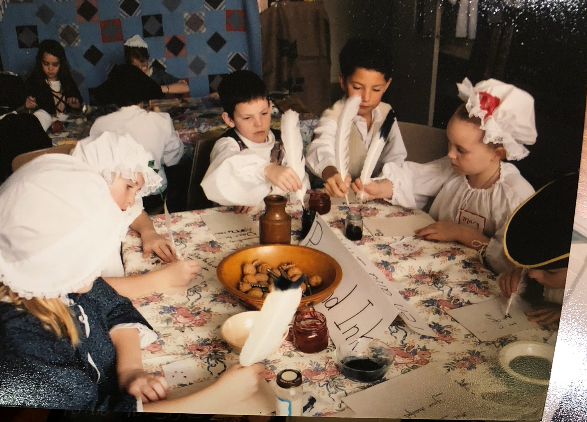
The English did not comprehend that the Indians valued their way of life, as most people do. Morgan argues that “The Indian way of life was of the kind that still generates, among those who practice it, a minimum of worldly goods and a maximum of leisure time.” They farmed only what they needed by rotating crops on land for 5-10 years and leaving it fallow from 30-40. While developed countries long thought of this as wasteful and backward, it has been shown that this system can produce more food per hour of labor than any other. They cleared forests for hunting that opened them and allowed for game, nuts, berries, fruits, and flowers unknown in the dense second-growth pine forests of Virginia today. Such hunting, gathering, and long-fallow farming societies require about two to six hours a day of work, far less than that of people in industrial societies. English gentlemen were far above labor. Everyone else was expected to work from before dawn until after dusk with such little pay they could not sustain themselves.
Those sent to develop Jamestown were a collection of English gentlemen who were above work and the poor who allegedly avoided it. “The Virginia Company had sent the idle to teach the idle” who sought to give “freedom to the free.”
Chapter 4: The Jamestown Fiasco
Morgan reviews the first ten years of the Jamestown settlement to explore why the colonists did not grow food for themselves and learn to prosper in the new land. The English were “unwilling or unable to feed themselves” and forever altered their good relationship with the Indians by bullying them for corn—or outright stealing or destroying it, as well as the Indians themselves. This was largely due to the terrible organization and direction of the settlement.
John Smith did not agree with the company’s policy of kindness toward “savages” and he was responsible for demanding corn from them. He believed slavery, or something close to it, was the best use of the Native Americans. In a change of heart from the Company, he was told to defeat the area’s tribes and make them pay tributes. Meanwhile, the Company sent various skilled servants for unneeded positions like iron ore workers and blacksmiths, or the “idle, criminal poor” who refused to work. These were not men who knew how to live off of the land, particularly in a new climate. They did not think that food would be a problem.
Their failure to grow food for themselves humiliated them as they relied on the Indians whom they regarded as savages yet were able to outperform them agriculturally.
After ten years, what shifted their fortunes was the tobacco that Indians smoked and grew. The English soon tried seeds from the West Indies and suddenly the idle became industrious as they planted tobacco, seeking profit.
Chapter 5: The Persistent Vision
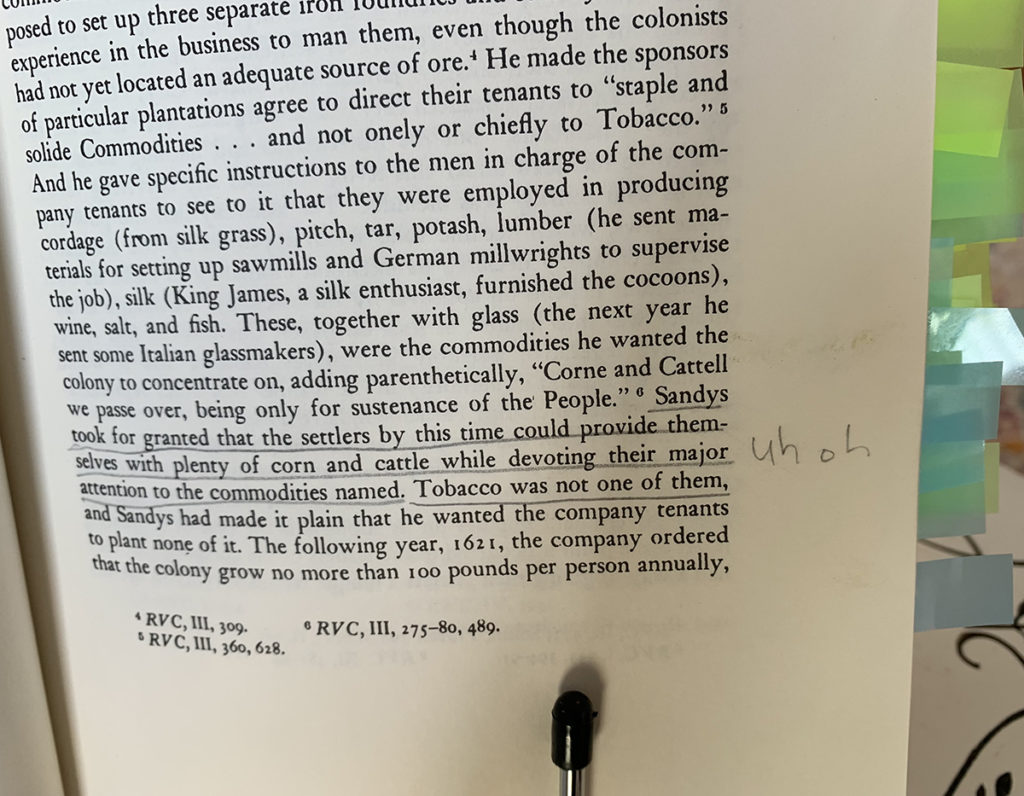
This chapter focuses on a shift in The Virginia Company program from militarization to increased benefits, namely land, for settlers. The company and the English government wanted the colony to produce crops more beneficial to society than tobacco, however no matter the plans back in England, tobacco was the crop of choice for it brought profit. Thousands of servants died in these years and relations with Native Americans further declined. Ultimately, The Virginia Company failed.
Chapter 6: Boom
The tobacco boom of the 1620s enriched planters, who were willing to work harder than they ever had, and make their indentured servants work even more. Morgan emphasizes a major part of his thesis—because most servants (more than half) did not live past their period of servitude and were thus not alive to receive the promised goods at the end, bringing multitudes of poor servants to Virginia and forcing their work was extremely profitable for planters. It was more profitable than slavery, in fact, because slaves cost twice and much and would likely die just as soon.
Though The Virginia Company suffered massive losses in London, many planters in Virginia were getting rich off of illicit means. They lied to their superiors in London and exploited their workers to the point that while they were not slaves, they were not free. And most would not live to see freedom.
The governor and his council, filled with the richest men with the most servants, held the power in Virginia. These men were able to control the government and as such all men of lower social rank, including freed servants. Their policies protected themselves and harmed others to lengths that Morgan considers likely unconstitutional. “Masters bent on profit ‘corrected’ their laggard, hungry, and diseased servants with barbarous punishments,” and to a further extent than in England. Courts usually sided with masters and Morgan sees this boom period as a time in which planters viewed their workers as machines for production, things rather than humans.
BOOK TWO: A NEW DEAL
Chapter 7: Settling Down
Though Barbados planters turned to slavery in the 1620s, Virginians did not in any scale, largely because their tobacco was not as profitable as sugar and they could not afford them, particularly when most servants or slaves died in the first year of American life. The Virginia elites beat, sold, and bought their servants to an extent that shocked other Englishmen, but did not enslave them “as we understand the term.” When the tobacco boom ended as the price of tobacco fell, the elites shifted their attention for the next three decades, to settling the land. Most Virginians had fewer rights than those in England and Morgan argues this period saw a focus on building a civil society.
The get-rich-quick tobacco scheme period ended and the decades of attention to corn production, though small, and the introduction of pasture farming, were finally supporting the colony. As life became more sustainable, colonists began to view Virginia as home rather than a stopping place. The elites began to focus on laws that would restrict the power of England—to them, freedom meant little oversight from the motherland. They set up counties, county courts, and county parishes, though they were much less religious than New Englanders.
The number of Blacks in this period was low, no more than 500 by 1650. They arrived as slaves, but some became free. Others were servants. All enjoyed more rights than they would when slavery became common. They were not treated more brutally than servants and some were able to earn money and buy cattle, or even their freedom. There are records of slaves being sold only with their consent. In short, 17th-century slaves had for more rights than later slaves would. Morgan argues that while racism affected Blacks, there is ample evidence that they were seen as capable members of the community subject to the same laws and rights of other non-elites.
While Virginia was built on English laws and customs, centered on pasture raising and exploitation of labor, it was quite different.
Chapter 8: Living with Death
The survival rate for newcomers to Virginia was less than half, largely due to Typhoid, which killed people in summer. This affected early Virginia society in that there were many doctors and quack doctors, though the difference between the two was unclear. They charged exorbitant rates and would bind free men as servants if they couldn’t pay. Women were scarce and usually widowed several times. They had greater economic advantages than in England, inheriting one-third of her husband’s estate which resulted in men marrying far older women instead of her daughters. Because land was plentiful it was not valuable. Cattle and servants were, the latter being more risky, and tobacco served as currency, often payable in the next yield. This created a unique system of credit and exchange.
Morgan pins the stabilization of life expectancy to population growth in 1644.
Chapter 9: The Trouble with Tobacco
New England achieved a much more balanced economy than could one governed by Virginia’s tobacco-dependent elites. Corruption was rife and the increased taxes imposed on tobacco by the King after the 1650s caused a struggle between the King and English merchants, on one side, and Virginia’s planters on the other. They all sought to press as much profit out of small planters and servants, who would pay far more to the king than he would keep in profit. The 1620s boom period was the worst for exploitation, but it did not end afterward, as elites built governing structures to exact as much profit out of the servants and small (often freed) planters as they could.
Chapter 10: A Golden Fleecing
After 1660, the King of England profited most from Virigina’s tobacco trade. He ended Virginia’s trade with the Dutch which cut the colony’s profits. Large planters, in turn, exploited the men who did the work of growing tobacco even more through the force of Virginia’s government. Meetings of the Virginia assembly, where corruption was rife, cost the lower class taxpayers dearly. Though survival of the servants increased, due to government laws that favored the rich, it became far harder to succeed in Virginia unless you were already wealthy.
PART THREE: THE VOLATILE SOCIETY
Chapter 11: The Losers
Virginia in its beginnings was structured around the intense loss of life of the people. As life expectancy rose, more servants became free, and these free farmers were a problem for the rich. If they kept growing tobacco on their own, they competed with their former masters and depressed the price. If they became idle they would become destructive to society. Either way, they posed a problem to the profits of the elites. So the government changed laws and society to limit the independence of freemen and further harm the servant. From the 1660s onward, tobacco enriched the king and his elites, the workers were “losers, and they did not much like it.”
Servants’ terms were extended and greater punishments were served for running away. Servants who gave birth or stole hogs (how runaways survived) had terms extended. Land in the safer, colonized areas was running out and owned by only a few, over 100,000 acres held by thirty men. Freedmen now had to pay rents or work for former masters. Those who did manage land had to pay larger planters to market and trade their crops. As the death rate fell, Virginia’s elite pressed freemen out of profit and “reduced the rights of those on whose labors they depended.”
Chapter 12: Discontent
Virginians were easily exploited “partly because they were selected for that purpose: they were brought to the colony in order to be exploited.” Englishmen, by which Morgan means “gentlemen,” thought of their colonies as a place they could make productive the “useless wretches” men of overpopulated England. Of course, they viewed this as charity and morally uplifting to their victims. They chose young men as most able bodied, and women were vastly outnumbered in Virginia. Their exploitability, however, could make them reckless when freed. The assembly decided in 1670 not to allow them to vote and used their power to submit the men in any way possible. Still, they often worried about revolt.
Chapter 13: Rebellion
Nathanial Bacon, a young newcomer with friends and family well-placed in Virginia society, was placed on the council by Governor Berkeley. A well-born Englishman, he did not like the nouveau riche of Virginia’s elite. He did not like Indians, either, though he settled upriver fairly near the frontier. A group of Virginia’s military elite attacked a group of friendly Indians, the Susquahanocks, which caused reciprocal attacks on the English. Bacon used the resulting anger and unrest of the poor frontiersmen to cajole a large group of freed Black and English men to rebel against Berkeley, whom Bacon found to be too generous with politically allied “friendly” Indians.
Thousands of Virginians joined Bacon against Berkeley and marched on Jamestown, forcing Berkeley across the river. Government forces put down the rebellion and Berkeley returned, still refusing to change his policy toward Native Americans. Bacon rallied his followers and killed nearby Occaneechi Indians in an assault.
At the same time, Governor Berkeley acted against the danger of angry freed servants, small landholders, and their Black allies. He called an assembly and changed laws to improve matters for poor freed men and pacify everyone but the Indians. The right to vote was restored for freedmen. Parish church vesteries were no longer co-opted but elected, petty officials could no longer collect fees for work not done, and councilors would now pay levies. These were aimed to stop the corruption of the few against the many. This did not stop the exploitation of servants but it did give a bit more power to the laboring class.
Bacon’s plan was to use the fear and anger of men who lived on the frontier, who were often subject to Indian attacks that Berkeley and his men did not protect them from, to provoke an attack against the ruling class. “The Indians would be the scapegoats. Discontent with upper-class leadership would be vented into racial hatred, in a pattern that statesmen and politicians of a later age would have found familiar.”
Bacon’s men marched from June until September of 1676, when they burned Jamestown to the ground. Bacon died in October, and the rebellion petered out, partly put down by British forces.
Chapter 14: Status Quo
The King made a large profit from Virginia’s workers and when the people he trusted to ensure that they work efficiently failed so miserably, he called a commission to investigate his lowly subjects’ grievances so they would get back to growing his tobacco. They found Berkeley and his friends seizing all the property they could. Just as the King had feared, the Virginian statesmen were abusing the people to the point they would no longer produce. Berkeley ignored his order of removal at first, but finally returned to England.
The King’s advisors struggled with the elite of Virginia over who could extract more from Virginia’s profits, and the concern for the rights of the small planter and laborers fell to the wayside.
BOOK IV: SLAVERY AND FREEDOM
Chapter 15: Toward Slavery
Viriginian elites could not get enough of indentured servants. The problem was how to keep them working for profit not their own. In the second half of the 17th century, they did this by making land scarce artificially (they would push the frontier forward when they wished for more land) which forced freemen back to servitude. As punishment, they extended terms of service. And they punished excessively hog killing, which allowed men to survive without work. They took as much of the “small man’s profits” as they possibly could through rents, taxes, and fees. These burdens forced Virginia into a continual brink of rebellion, and the elites began to seek another way.
“Slavery is a mode of compulsion that has often prevailed where land is abundant, and Virginians had been drifting toward it from the time when they first found something profitable to work at. Servitude in Virginia’s tobacco fields approached closer to slavery than anything known at the time in England. Men served longer, were subjected to more rigorous punishments, were traded about as commodities already in the 1620s” (296). It was not due to moral repulsion that elites did not switch from servants to slaves, but because it was economically advantageous. Until life expectancy stabilized, it was not worth paying for a slave, twice the price of a servant. Planters in Barbados were far wealthier from their sugar crops and could afford slaves, which were cheaper in Barbados because closer to Africa. It was also far more difficult to force servants into the intensive labor required by sugar. Africans were more accustomed to work in the heat and were more brutalized than servants.
By the 1660s, the switch to slavery began. There was a decrease in poor English coming to Virginia because the conditions of labor had become notorious. There was also less pressure to leave England, as overpopulation had subsided. As life expectancy grew, it became more profitable to buy slaves who would now survive long enough to increase owners’ profits. By 1700, half of Virginia’s labor force was enslaved and between 1702 and 1708, almost no white servants had been imported. “The substitution of slaves for servants gradually eased and eventually ended the threat that the freedmen posed: as the annual number of imported servants dropped, so did the number of men turning free.”
Chapter 16: Toward Racism
Morgan describes the English attitude toward their poor in order to contextualize forced labor. The statesmen and economists who wrote on the problem of the poor said that half of the English population “would rather drink than eat and rather starve than work,” the worst of whom were beggars and thieves. “The English poor were “vicious, idle, dissolute,” but as the concept of populations serving to create wealth became popular, the English asked how best to “hold them [the wretches] down and extract the maximum labor from them.” In the 1600s, they founded institutions to force “the sick, the criminal, and the poor” to make them contribute to England’s wealth. Prisons, called workhouses, became a place to extract work from “the criminal, the insane, and the poor alike.” Several English thinkers of the era endorsed enslaving the poor, but the government stopped short of it.
Stereotypes of the English poor tracked with those of African slaves, “even to the extent of intimating the subhumanity of both: the poor were ‘the vile and brutish part of mankind’; the black were ‘a brutish sort of people.’”
Morgan found no evidence that English servants resented working with African slaves rather than white Englishmen. Rather, they seemed to believe they shared the same problems. They often “ran away together, stole hogs together, drank together, and made love together.” During Bacon’s Rebellion, they revolted together.
This chapter supports a central theme of his argument. Before 1660, when Blacks were a minority, it was possibly difficult to tell racism from classism. The solidarity between Blacks and whites was not a problem when Blacks were a small part of the labor force. But Bacon’s rebellion made the elites’ fears of insurrection real, and their response was to codify racism.
Morgan also addresses religion. Before 1660 slaves were thought to be non-Christians, but as the century advanced, they were thought to be Africans. This tracks with Katharine Gerbner’s argument in Christian Slavery.
Through law, they separated “dangerous free whites from dangerous slave blacks by a screen of racial contempt.” The Virginia assembly in 1670 prevented free baptized Blacks and Indians from owning Christian servants. Ten years later it instructed thirty lashes if a slave or Black “lifted up his hand in opposition to any christian” which allowed servants to bully slaves and lifted his status. By 1705, the assembly protected the property of servants and forbid slaves from owning property. In an act that legalized the mutilation of “unruly” slaves, they also determined that servants had sole rights to their property but any cattle or horses that belong to slaves was confiscated by the local parish, which gave the animals to poor whites. The intent was to create animosity between the races and a psychological superiority in poor whites.
Until and even through the 1660s, when more slaves were brought to Virginia, there is little record of “indisputably racist feeling about miscegenation.” There were however laws against Christians having sex with Blacks—similar again to Gerbner’s argument about Protestant supremacy before white supremacy. Morgan gives several examples of interracial marriages before the assembly passed an act in 1691 “for prevention of that abominable mixture and spurious issue which hereafter may increase in this dominion, as well by negroes, mulattoes, and Indians intermarrying with English, or other white women, as by their unlawfull accompanying with one another.” This act punished miscegenation of any kind.
A white person who married an Indian, Black, or mixed person would be banished from Virginia. In 1699 there was a petition to the assembly to repeal this act, which was ignored by the House of Burgesses. They also passed on a request from the justices of a “poor man’s county,” Surry, to tighten the law, indicating that interacial marriage was common there. As not to lose laborers to banishment, in 1705, they changed the law to six months in prison and a fine of ten pounds (about $2,760 in 2022). The presiding minister was fined 10,000 pounds of tobacco.
These acts were far more concerned with the sexual relations between white women and black or mixed men. A free white woman who had a child out of wedlock by a black or mixed father was fined fifteen pounds or sold for a five-year term if she could not pay. Her child would spend 30 years in servitude to the parish. If she was a servant, her term was extended by two years and then sold for another five. The proceeds of her sale were divided between the king, the parish, and the snitch. These laws were directed toward protecting white women, viewed as the rightful property of white men (many had arrived in America because they had been sold as brides). Between 1690 and 1698, about twenty illegitimate mixed children were born in three different counties, even with these penalties. These children threatened the separation of Black and white.
Black women who born mixed children were usually slaves and their children were identified in law as Black slaves to insure that the child would not be free. The 1691 assembly forbid planters to free slaves without transit out of Virginia and later forbade it altogether save a special consideration granted by the council and governor. If an owner did free a slave, the council encouraged the seizure and sale of the freed person. Free blacks in Virginia were denied the right to vote, testify in court, and hold office. Black women were subject to taxation whereas white women were not. In these acts and others the elites intentionally fostered white contempt for Blacks and Indians by intentionally degrading the status of Blacks.
Chapter 17: Toward Populism
As politicians shoved down people of color, they simultaneously started to increase the rights and status of poor and working-class whites, moving them slightly closer to the elites in law. As life expectancy rose, poor freemen grew to problematic numbers. But with the switch to slavery there were fewer and fewer freemen and their financial situations improved.
While poor laws continued in the early 18th century, they were passed shortly after English Parliament allowed courts to send convicted felons to Virginia to serve for seven to fourteen years. Others were sent off to fight the Indians, French, or Spanish in places such as Georgia, Cartagena, and the Ohio Valley. Otherwise, the numbers of free poor men declined and both rich and poor whites grew wealthier, as titheable records and land records in the Tidewater show.
At the same time, lower-class white men also gained political attention. Social and political attitudes changed with the rise of slavery. It began when the King tried unsuccessfully to restrict the powers of the elites after Bacon’s Rebellion. This created a struggle between the crown and Virginia’s governors on one hand and Virginia’s magnates in the assembly. Governors tried to create policies that aided the crown and the small planter by limiting the power of Virginia’s elites. This struggle bore new tactics in the 1690s, when the assembly passed acts that aligned all white men against all men of color. With new voting rights for small land-owning whites, the powerful now aimed to “court their good will.”
This was obvious in 1699, when the assembly forbade candidates to “‘give, present or allow, to any person or persons haveing voice or vote in such election any money, meat, drink or provision, or make any present, gift, reward, or entertainment … in order to procure the vote or votes of such person or persons for his or their election to be a burgess or burgesses.’ It is, of course, no sign of democracy when candidates buy votes, whether with liquor, gold, or promises. But when people’s votes are sought and bought, it is at least a sign that they matter” (358).
Morgan argues that these new politics were not a surrender to the mob but in fact a “new triumph for the men who had dominated Virginia from the beginning.” For those who suspect that American merchants have manipulated the people into believing in freedom and democracy, this argument will resonate. By the 1720s, some policies were designed to reign in Virginia’s elite and to benefit the “small man.” But the Virginia barons accepted none and they did not have to accept them. They were able to convince voters to keep elites in office even with populist politics.
Chapter 18: Toward the Republic
Large and small landowners, with a vast gap in wealth, still had some common interests. Both wished to protect their land and tobacco crops from restrictions and taxation in London. Planters in Virginia were fond of republican thinking, and Morgan argues that poverty was as great a threat to liberty as monarchs and greedy landlords. English hatred and abuse of the “wretched” poor was absorbed, in Virginia, by racism. “Racism made it possible for white Virginians to develop a devotion to the equality that English republicans had declared to be the soul of liberty” whether they had access to that liberty or not. By lumping all people of color into one abused class, they created a binary that on the other end lumped together large and small planters into a favored class.
“Racism became an essential, if unacknowledged, ingredient of the republican ideology that enabled Virginians to lead the nation.” To close, Morgan asks if Viginia was typical of Amercica, and if northerner republicans believed America could become a world power without slavery. They did not. “They allowed Virginians to compose the documents that founded their republic, and they chose Virginians to chart its course for a generation…But were the two more closely linked than his conquerors could admit? Was the vision of a nation of equals flawed at the source by contempt for both the poor and the black? Is America still colonial Virginia writ large? More than a century after Appomattox the questions linger” (387).