Daniel Walker Howe. What Hath God Wrought: The Transformation of America, 1815-1848. New York; Oxford: Oxford University Press, 2007.
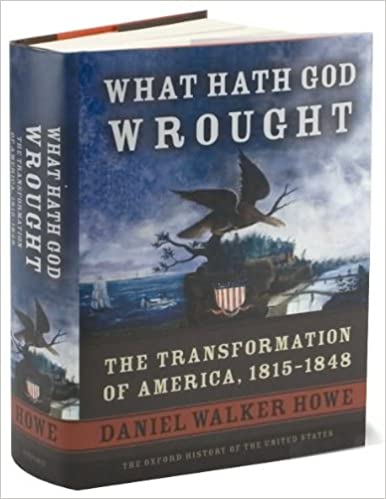
CATEGORIES: Oxford History of the United States (i.e. Elite White Male History), Political History, Antebellum U.S. History, democracy, U.S. Government, Jacksonian America, Western Expansion, Economic History, Religion, Reform, Whigs, Communications Revolution, 19th-Century Social Change, Economic Conditions.
PLACE: United States
TIME PERIOD: 1815 (post-War of 1812) – 1848 (post-Mexican-American War).
TAKEAWAY: If only the Whigs had won.
SUMMARY:
In this Pulitzer-Prize winning synthesis of early 19th-Century U.S. History dedicated to the long-dead President John Quincy Adams, Daniel Walker Howe pushes against the narratives of Charles Sellers (whose text for this installment of the Oxford History of the United States was rejected for not sufficiently embracing capitalism), Sean Wilentz, and Arthur Schlesinger Jr. Jacksonian Democracy did not exist.
In Howe’s view, the Whigs were the champion reformers of the day and Jackson and his followers were small-minded, white-supremacist bigots. There is no nuance here, only John Quincy Adams and the good Whig “Improvers,” high off the Second Great Awakening and rightly wary of the rabble’s ability to vote, up against the evil white-supremacist Jacksonians. One gets the feeling that Howe is trying to create a lineage for the centrist-Democratic party of today, Whig fore-bearers who would have freed slaves and granted women and people of color equal access to the law had that terrible Jackson not won the Presidency so often. Never-mind that the repression of these groups continued long after the Republicans (the party the Whigs fled to after the demise of the Whigs in 1856) gained power. The fantasy that Native Americans were treated well by any dominant politician or party in the U.S., outside the protection of their own political and financial interests, needs to be checked.
Breaking with historiography again, Howe explains (following others) there was no market revolution in this period. Farmers were delighted to bring their goods to market and enjoyed the items they could buy (when and if they could afford them). Instead, there was a communications revolution that pushed the religious and cultural movements of the period. Canals and steamships helped move things forward as well, and the Whigs embraced progress through a bold plan for national infrastructure and commerce.
Howe spends most of his time on wars, state, and politics, with cultural notes sprinkled throughout, particularly those of the American Renaissance and religious movements. These are tied together with the overarching theme of technological advancement, embraced by the Whigs as technologies of advancing self and society.