Jeanne Boydston. Home and Work: Housework, Wages, and the Ideology of Labor in the Early Republic. New York: Oxford University Press, 1990.
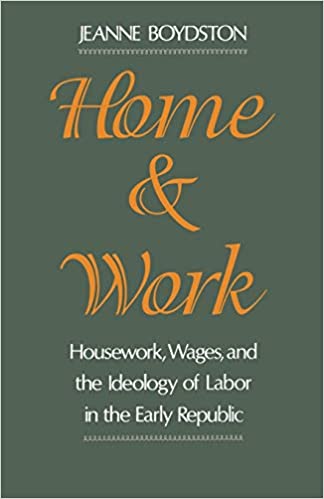
by Jeanne Boydsto
CATEGORIES: Cultural and Social History, Early U.S. History, Women’s History, American Ideology, Labor History, Republican Motherhood, Domestic Work, Housework, Housewives, Wage History, Home Economics, Economic history, Feminist Marxist analysis
PLACE: New England and New York
TIME PERIOD: Early 1600s-1861
TAKEAWAY: to come
SUMMARY:
In 1990, Jeanne Boydston examined the intersection of class and gender in the now somewhat defunct “sphere” of private domestic life. In the early colonial period, women’s production and reproduction—work—was acknowledged and valued as contributing to the family economy. By the end of the seventeenth century, the rise of commercialism began to limit the definition of production as both masculine and performed outside the home, which shifted women’s domestic work outside the sphere of labor and production. As labor became accountable to capital, housework became accountable to paid labor—male workers.
Though this shift began in the mid-1600s and accelerated in the 1740s, in the Revolutionary period there was a temporary halt, as women’s work was held up as patriotic and crucial to the war effort, especially making fabrics, clothes and blankets for the war effort, as well as using American made goods and boycotting British goods, as we saw in Kerber’s Women of the Republic. But this quickly shifted back to the diminishment of women’s work, as citizenship was not defined by productivity but by economic citizenship. The republicans of the era feared a government by the people and “a commitment to the commonweal, industriousness, virtue, and a love of equality” (38) were crucial, but most important was economic standing so that the citizen would “ not be susceptible either to bribery, to threats, or to promises of wealth.” As such, women were written out of this economy, as their domestic productivity was ignored by the larger economy and, subject to coverture, they could not own property.
Further, republican motherhood was valued whereas housework, more time consuming and grueling, was not. Women, nevertheless, sold home manufactures, food, home sewing, scavenged goods, and also took in boarders. Still, the home was idealized as a safe refuge from the hubbub of technical modernization and the marketplace. Women were expected to be useful home economists but were treated, at the same time, as if decorative and useless. Their work was simply a manifestation of love and comfort rather than valuable labor and goods. This occurred as wage labor began to define men’s lives in the early Republic.
Boydston argues, following Marx, that the exchange value of work or goods are not dependent on their usefulness, but on market relations and status (28). Though housework was and is essential to capitalist production, its value was canceled in the developing relations of power in the market economy, which placed housework in the service of laborers and laborers in the service of capital. Women were denied the value of their work.
Yet, Boydston demonstrates that the home was a “mixed economy” where women’s labor filled gaps between cash income and necessity. She estimates the value of women’s domestic work based on class. Working class women’s housework she values $250-500 above her personal cost and assured the survival of the family. Middle class housewives she values at over $700 and added to security and status. Women’s work was simply about being women than completing valued labor, which devalued women in society. No longer subservient but valued as in the colonial era, women’s work was both subservient and “pastoralized” in the industrializing eighteenth century.