The Marketplace of Revolution

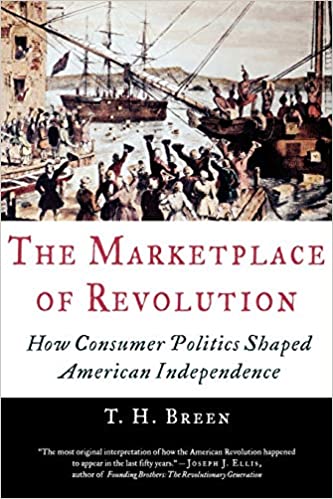
T. H. Breen. The Marketplace of Revolution: How Consumer Politics Shaped American Independence. Oxford: New York: Oxford University Press, 2004.
CATEGORIES: Cultural and Social History, Early U.S. History, Colonial U.S., Capitalism, American Revolution, 18th-century Economic History, Material Culture, Marketplace Revolution

PLACE: Early United States

TIME PERIOD:  1740-1774

TAKEAWAY: The consumer revolution of mid-17th century American formed a common cause amongst the diverse and geographically dispersed US colonists as they came together in a trusting “imagined community” (per Benedict Anderson) to revolt against the British Empire.

SUMMARY:

T.H. Breen extensively documents the material culture of the American colonies in the decades before the Revolution to argue that the new consumer marketplace created an imagined community of consumers who rebelled against the English. The unjust taxes that the Crown imposed, in the 1760s and 1770s, on the colonists’ new and beloved consumer goods cause rebellions that came to define them as political individuals. Rather than Bailyn’s ideological revolution, Breen offers a movement based on the marketplace, the common man and quotidian life. The book “explores how a very large number of ordinary Americans came to the striking conclusion that it was preferable to risk their lives and property against a powerful British armed force than to endure further political oppression.”

Breen answers this oft-explored question by arguing that it was through a new language of shared consumer experience. People of different classes and genders developed radical methods of resistance, particularly through the boycott. They would suffer together the deprivation of English manufactures, sacrificing for the common cause of revolution. Similar groups in different colonies found common ground and transformed politics and society through the popular press and collective imagination.

PART ONE: AN EMPIRE OF GOODS

The American colonies, by 1750, had become an “empire of goods.” From Georgia to Maine, “even the most humble” Americans bought similar consumer items which connected them in an imagined community. They discovered a shared experience in personal choice, which Breen believes did not exist before the marketplace revolution.

PART TWO: A COMMERCIAL PLAN OF POLITICAL SALVATION

Breen dismisses Christian virtue and republican virtue for liberal consumer virtue, or “bourgeois virtue.” “When ‘A Farmer’ praised the ‘honest man,’ he had in mind a person able to exercise self-restraint when tempted by a brilliant array of imported British goods” in the consumer marketplace. It was someone with honor and character who would deny himself “private pleasures” for the public good. Too much personal debt was a danger to the common good, and this concerned the virtuous man. This bourgeois virtue did not require one hold property (at least not much) or title—only that she or he could buy goods, something literally any free person could do.

This shared experience gave them the resources to develop resistance grounded in the marketplace—particularly the boycott. Breen argues that American colonists were the first to organize mass political boycotts, just visited in Linda Kerber’s Women of the Republic. If we recall John K. Thornton, American Indians used trading boycotts against the English, and Jill Lepore discussed the abolitionist Quaker Benjamin Lay’s political refusal of slave-made goods in These Truths. However, Breen argues that private consumption was transformed into intentional public and communitarian acts of resistance after the Stamp and Townshend Acts. The latter taxed indirectly English commodities like tea, paper, lead, glass, and paint. The boycotts that followed allowed ordinary people a voice in politics never before experienced.

Those who consumed the boycotted goods were suspect, and people learned trust in their follow colonist near and far, sometimes disappointed, but always persevering. By the books close before the Revolution in 1774, this trust and community extended to shared liberties and rights of the common man. Thus, this was the first revolution “in recorded history to organize itself around the relation of ordinary people to manufactured consumer goods.” Breen believes that this resistance in the consumer marketplace was in fact a revolutionary politics of “pursuing happiness.” In Breen’s telling, stuff is the basis of American liberty, after all.

Ideological Origins of the American Revolution

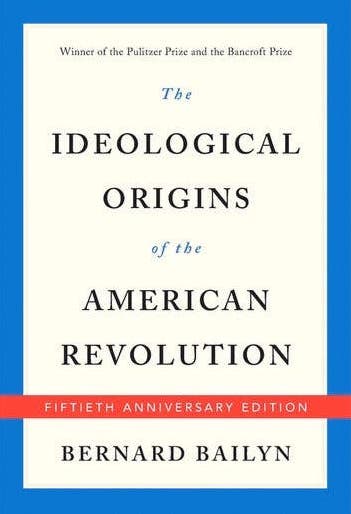
Bailyn, Bernard. The Ideological Origins of the American Revolution. Cambridge, Mass: Harvard University Press, 1967.

The Ideological Origins
of the American Revolution

CATEGORIES: Intellectual history, Political history, Constitution, Early U.S. History, Colonial U.S., democracy, U.S. Government., American Revolution

PLACE: American Colonies and England

TIME PERIOD: 1640-1800.

TAKEAWAY: “Study of the pamphlets confirmed my rather old- fashioned view that the American Revolution was above all else an ideological, constitutional, political struggle and not primarily a controversy between social groups undertaken to force changes in the organization of the society or the economy [contra Charles A. Beard].”

SUMMARY:

While Bernard Bailyn has received plenty of criticism for being a relic of his time, few academic history books stand up to half a century of discussion. The book is, first and foremost, an intellectual history, which very clearly defines its parameters in the 17th and 18th American centuries to that of privileged white men. Bailyn was a legendary historian, and one of the first to plug data into a computer to retrieve historical insights. It is interesting, clearly written, and won both the Pulitzer and Bancroft.

Bailyn examined the pamphlet literature, which best expressed the forming thoughts of the era, of revolutionary writers to understand the ideas behind the revolution. These privileged white men were not philosophers or literary writers (in fact, often the writing was quite rudimentary), nor were they removed from the realities of daily American life. They were merchants, plantation owners, lawyers, politicians, and preachers who were interested in keeping and expanding their power, which the flexible forms of government in the early American colonies had permitted them the 17th century, particularly when the English Crown began to crack down and limit these liberties in the 18th century, largely for the profit of the motherland.  

Should be working but…snow day needs.

As they considered and, importantly, used, the ideas they had inherited from Greek antiquity, English common law, the Enlightenment philosophers, Puritan covenant theologians, and crucially for Bailyn, the English commonwealth thinkers, the “country men” and radical Whigs who challenged the monarchy in the 17th century English Civil War. The writers of Cato’s Letters, John Trenchard and Thomas Gordon, were particularly admired and quoted. 

These pamphlet-writing merchants, lawyers, and other landed men, alarmed by corruption in English and political dangers in the colonies, concluded that they must “destroy” the political and constitutional system that governed them and create something new. This new state would recapture their progressive ideals and the “public life of separate states” with “no claims to the powers of nation-states. Finally, they would create a federal government that would rule over the states only in the crisis of war. The process of creating this nation-state threatened their ideological revolution, which forced them to rethink the original principles that led them to victory, modernize and refine them, and reapply them to their federal state. “In the end they found themselves fulfilling their original goals by creating power, on new principles, not by destroying it” through “natural endowments of humanity based on the principles of reason and justice.” While the ideology of the revolution and constitution were abundant in England and elsewhere, the way these men put the ideas into action was distinctly American. America’s special place in the eyes of God was a part of this ideology.

The disposition of power was central to the colonists’ political theory, which John Adams described as dominion. “Power to them meant the dominion of some men over others, the human control of human life: ultimately force, compulsion.” Those who held it had a tendency to push past “legitimate boundaries” and tread on power’s “natural prey, its necessary victim…liberty, or law, or right.” Power is on one side, liberty and rights on the other. Power is “brutal, ceaselessly active, and heedless” while liberty and rights are “delicate, passive, and sensitive.” How fascinating that these qualities are associated with the masculine and feminine. Hence Lady Liberty?

Power was not essentially evil but natural and necessary. If its foundations were “in compact and mutual consent” with restrictions that virtuous men understand and accept as necessary to the public good, this allows society to grow “from a state of nature and create government to serve as trustee and custodian.” What made power problematic was not the nature of power but of man. “his susceptibility to corruption and his lust for self-aggrandizement.” To contain the power of men in government, the people must have checks on their power through a constitution of government systematized for the good of the whole community. As such, the vigilance and morals of the people were utmost. Industrious, Protestant and Saxon people were ideal for this task. While these concepts were English in origin, the English at home had fallen under the sway of corruption and had forgotten their ideals since the English Civil War, when the English standing army turned against their own. 

The English system of checks and balances, the separation of government, became problematic: “If, particularly, the agencies of power— the prerogative, administration—managed, by corrupt practices, to insinuate their will into the assembly of the commons and to manipulate it at pleasure, liberty would be endangered.” These issues intensified for the colonists after 1763 when English raised taxes to pay for the Seven Years War (French and Indian War). Taxation without representation and the arrival of an English standing army in Boston to enforce the unjust taxation increased the alarm of the pamphleteers, who spun these actions, their hatred of corruption, and yearning for liberty into fears of various conspiracies by the English. 

After the Revolution the (elite) phampleteers discovered that idealism in practice could be dangerous, as in slavery and religion, two institutions that challenge these notions of liberty. So was “democracy,” as clearly commoners could not be considered virtuous or capable of understanding the common good (according to Bailyn). As such, “stability” (or status quo) won over democracy. These issues were debated by the pamphleteers. 

Through his reading of pamphlets, which had previously been viewed by historians as propaganda, Bailyn wove a groundbreaking thesis of ideological revolution in America. He broke with the prevailing theories of social and economic causes to argue for an intellectual reading of the U.S. Revolution. 

HISTORIOGRAPHY:

Arendt, Hannah. On Revolution. New York: Penguin Books, 1963.

Bailyn, Bernard. Pamphlets of the American Revolution, 1750-1776. The John Harvard Library. Cambridge: Harvard University Press, 1965.

Brown, Robert E. Charles Beard and the Constitution: A Critical Analysis of An Economic Interpretation of the Constitution. Princeton University Press, 1956.

Hofstadter, Richard. “The Paranoid Style in American Politics.” Harper’s Magazine. New York, N.Y.: Harper, November 1, 1964. 

Morgan, Edmund S. “The American Revolution: Revisions in Need of Revising.” The William and Mary Quarterly 14, no. 1 (1957): 3–15.

Robbins, Caroline. The Eighteenth-Century Commonwealthman: Studies in the Transmission, Development and Circumstance of English Liberal Thought from the Restoration of Charles II until the War with the Thirteen Colonies. Cambridge, Mass: Harvard University Press, 1959.

error: Content is protected !!