PLACE: Virginia, Maryland, North Carolina, New York.
TIME PERIOD: 1675-1725.
SUMMARY:
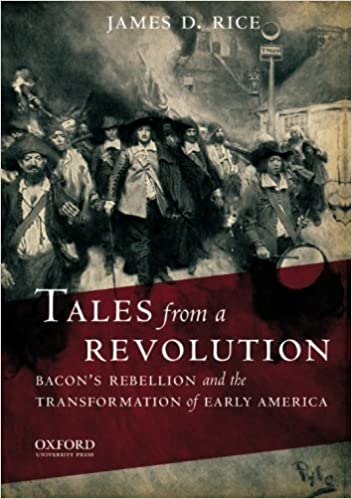
James D. Rice’s short revisionist narrative of Bacon’s Rebellion and the following decades provides a new but familiar thesis—he is unable to support, particularly in such a short book. The synthesis history of the rebellion itself is an enjoyable read, as is the aim of the “New Narratives in American History” series from Oxford University Press, but the entire second part of the book concerns an argument about anti-Catholic conspiracy, which seems strange to a colony known for its irreligion. While Rice builds on Morgan’s American Slavery, American Freedom, he omits pivotal facts from Morgan’s thesis to ultimately argue that were it not for those poor, racist white populists, Native Americans would be thriving in the United States today.
Rice explains in the Afterward that his narrative style precludes a traditional academic thesis, but has allowed him to write in a way that readers must think for themselves about events in order to discover the truth of his thesis, which he spells out at the end of the book. I recommend reading this at the beginning.
The Afterward begins with a valuable historiography that explains the various turns the narrative of Bacon’s Rebellion has taken, before a segue to the benefits and pitfalls of narrative history. Next he hits on a sub thesis, closely related to his main argument, which echoes loudly in 2022. Reliable information was hard to come by for 17th-century Virginians, who “made their choices in the absence of information, operating within what is often called the “fog of war—which, as the great Prussian military theorist Carl von Clausewitz described it, “gives to things exaggerated dimensions and an unnatural appearance.” The unreliable stories of Sarah Grendon, Thomas Mathew, and Nathaniel Bacon indicate that “gossip, rumor, misinformation, and contending stories,” the “wild, irrational tales, full of paranoia, supernatural forces, superheated rhetoric, and outright misinformation” ruled the day (209). It’s telling that Rice does not include Berkeley in his list of unreliable narrators, for, while he concedes that Berkeley was corrupt and had little concern for the frontiersmen whose lives buffered the wealthy planters from the Indians, he believes that Berkeley was in the right. The belief in the supernatural was (and arguably still is, outside of academia, in all social classes) commonplace in this era was well established by historians such as David D. Hall.
The rebellion was caused by the settlers’ “fear, anger, and suspicious-mindedness; their paranoia and susceptibility to conspiracy theories; their vengefulness and malice; and their willingness to resort to violence, savagery, oppression, and cruelty when they felt threatened by Indians, governors, “Papists,” or anyone else outside their tribe.” Ah yes, those poor, tribal whites. Never mind the violence, savagery, oppression, and cruelty of the governors and the assemblies in their never-ending pursuit of profits. Never mind that poor, white indentured servants rebelled side-by-side with Black slaves. And never mind that the poor whites forced to the edges of the frontier by elites were frequently victims of Indians “violence, savagery, and cruelty” when the wealthy ruling class pushed them off their land.
To believe Rice’s argument requires forgetting, or ignoring, that Berkeley, long-known as an diplomat par excellence to his Indian trading allies, thirty years previous had forced the Powhatans off their land around Jamestown, killed their chief, and almost obliterated the tribe of over 10,000, by far the largest of the area. After subduing the tribe he engaged them in fur, skins, and Indian slave trade. Confusing a wish to protect his financial interests with a special concern for Indian rights is dubious and buys into a “good Indian, bad Indian” narrative (see Thornton). What his and other texts demonstrate is that white English elites used Indians when it served them and turned on them when it did not. That we are to believe that wealthy colonists did not take lands from the Indians when it suited them and when they could, that instead it was the fault of the “savage, superstitious, tribal” poor white populists is quite a fantastic thesis. But it does serve a certain political position and psychological viewpoint—that racism is the fault of racist, “tribal,” poor whites over there, rather than baked into the systems and psychology of the United States. As Morgan suggested, racism serves elites today as well as it did in 1676.
More welcome in Rice’s analysis is his inclusion of Indians’ experiences during this period. He details how English gentlemen pushed Indians westward and southward, as did the powerful Five Nations Iroquois of the mid-Atlantic region. Tribes that migrated had to negotiate with tribes already inhabiting those areas, who often used different languages. These negotiations often turned into wars, and larger tribes subsumed others as more and more Indians were dislocated.
In Part Two of the book, Rice argues that Bacon’s rebellion was not a short period of insurrection led by the notorious Bacon. Instead it was a series of rebellions caused by various political alliances and the displacement of Indians. In Rice’s telling, Bacon’s Rebellion was not against corrupt royal authority but against authority that would not remove frontier Indians’ from their lands. Rice suggests this is because of white tribal racism, ignoring the facts that the elites intentionally restricted freed servants’ access to land to decrease their power and increase the value of the elites’ land. Nor did the government seek to protect the poor whites on the frontiers who were often killed by Indians seeking revenge on actions taken by government officials. We are not asked to consider why, exactly, poor men brought, often by force, to settle and work in servitude in a faraway land with shocking morbidity rates, might be angry.
Instead we are told that the Baconites were summoned by a tract called “A Complaint from Heaven with a Huy and crye and a petition out of Virginia and Maryland ” written anonymously late in 1676, before the rebellion had been squashed. It called for a continuation of the rebellion due to Lord Baltimore’s mistreatment of his people through his alliances with Indians. He was against the people because he was a papist Catholic in alliance with Indians and the French in Canada, who were drawing closer and closer to Virginia. Bacon’s Rebellion, Rice argues, was not against royal authority but against Catholicism and the threat of Louis XIV. They continued to rebell in the 1680s and followed closely the Glorious Revolution, believing a Protestant king would serve their interests. Indeed, when William III claimed the throne in 1889 he placed Francis Nicholson as royal governor. Nicholson allegedly followed the desires of the Baconites and henceforth used broadstroke anti-Indian policies. It was not because trade with Indians for skins and Indian captives was, by the 1690s, no longer enticing for the elites, but because of the desires of the racist rabble.
The connections between Bacon’s Rebellion, the Glorious Revolution, and Coode’s Rebellion are unclear. Though Rice elaborates in his afterward, there is simply not enough evidence presented to make the connections believable. While his independent analyses carry weight, that they are all bound up together is problematic. While he asks at the end, “What if Bacon had died young?,” suggesting that perhaps Indians would have prospered under more Berkeleys and Baltimores, I was instead convinced that given the numerous uprisings before and after Bacon, and the elites’ need to control the exploited poor, and the shifts in Indian economies, these trends would have developed with or without that particular sorry rebel.
CATEGORIES: Cultural History, Atlantic History, Early American History, African History, European History, Colonial History, Civilization.
PLACE: Europe, Africa, North and South America.
TIME PERIOD: 1250-1820.
TAKEAWAY: Oh, so many (tk).
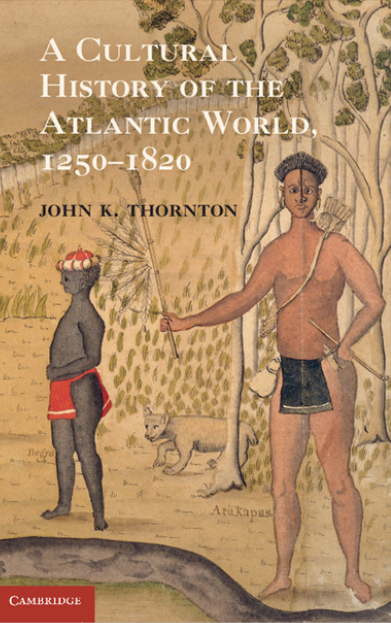
SUMMARY: John K. Thornton hopes to change our cultural memory from a U.S-Eurocentric story to include an understanding of the relationships between Africa, Europe, and the Americas to that we can revise our heritage. The result is A Cultural History of the Atlantic World, 1250-1820, the product of decades of his teaching and research in several languages.
As I read it, I thought, “A reviewer is going to call this ‘magisterial,'” and indeed, they did. It is a beautiful book. Though it is not a narrative, it is clearly written and a pleasure to read.
Thornton organizes the book into four parts. The first, “The Atlantic Background,” explains early exploration in the Atlantic basin. Part II, “Three Atlantic Words” surveys the cultures of Europe, Africa, and the Americas. Part III, “The Nature of Encounter and Its Aftermath, and Culture” sorts the encounters of the varied peoples and cultures into three types: Conquest, Colonization, and Contact. Though the title refers to a cultural history, these three parts are largely social and political, and indeed, Thornton sees himself as a social scientist. Part IV, “Culture, Transition, and Change,” offers a cultural comparison of these regions to understand the dynamics of linguistic, artistic, religious, and revolutionary practice and change.
Thornton seeks to revise the narrative of American and European history from one of superiority, conquest, and military might to one of nuanced encounters, often between equals. He emphasizes the advantages that Europeans had in the effect of their diseases in the Americas, as well as the political systems in Africa and the Americas that allowed them to exploit enemy groups or nations and make military alliances that allowed them to win many wars they could not have (and often lost) with their more advanced weaponry alone. There is a concerted focus on African and Native American agency.
Though extensive, I found this book to be both helpful and enjoyable. As a modern Americanist, it both offered new information and filled in gaps in my knowledge.
For example, Knight culture in Europe developed around 1000 in the Lower Rhine Valley. The pinnacle of advancement came at the end of the 11th century, when horse training, shields, armor, and weapons reached their peak development, affording Knights great power over the monarchy. Their political struggles would later influence how European expansion developed and influence the later American revolutions.
PART I: THE ATLANTIC BACKGROUND
Though Europeans had nautically advanced ships that crossed the ocean, otherwise they were not more advanced than other cultures, and their prowess in the sea was not necessarily helpful on land, where encounters took place.
Chapter 1: The Formation of the Atlantic World, 1250-1600
Many peoples of the Atlantic Basin explored the sea with various craft, but it was not until the 1400s that the “Atlantic Highway” became regularly used. The Scandinavians regularly crossed the North Atlantic to North America in the 11th and 12th centuries but expanding ice ended their trade and settlements by the start of the 15th century. Pliny, in the first century BCE, wrote of strange, shipwrecked people in Germany he oddly called, “Indians.” Thornton shares several anecdotes of unknown foreigners found on European shores and also discusses African navigation of the Atlantic, possibly to the Americas.
Though people had been trading by sea for centuries, it took hundreds of years to master the Atlantic because of its currents that wind-powered ships must abide. The Canary current runs south from Portugal, along the coast of Africa, and, just south of the Canary Islands, shifts west across the ocean to the Lesser Antilles. Its flow does not reverse, so a return trip to Europe required knowledge of the Gulf Stream, another one-way current that sent ships north from the Caribbean up the North American coast then back east to Europe. Near the Azores Islands, the outer eddies of the two currents are close and once sailers learned that the southern “outbound” current flowed far west and the “inbound” current fairly close to the north created a circle that would allow travel to the Americas and back.
Thornton adds the note that Columbus discovered this because his Portuguese wife lived in the Azores and he knew the surrounding seas well. He could risk sailing out into the Atlantic because he knew the return current home. This was well known to sailors of the area and thus the fable of his terrified crew begging to turn back is a cultural myth. They knew that a ship cannot turn around in a oneway current.
Columbus was not a scientist or explorer but a trader and low knight who happened on the Americans by way of extremely lucky accidents that had built since the 1200s, with the start of the grain trade. By 1277, Mediterranean cities looked for cheaper grain in coastal areas outside the Mediterranean in other parts of Europe. One merchant was blown off course and landed in the Canary Islands, where he developed trade with the locals. This led to encounters in Madeira and West Africa, and eventually the knowledge of the paired currents. “In the end, the voyaging into the Atlantic was not part of a grand scheme, but a haphazard collection of adventures organized by lower knights and merchants willing to take some risks for profits” (18).
In the Canaries in 1424-25, the native inhabitants, the Canarians, defeated a Portuguese army with mounted knights and foot-soliders by throwing stones that knocked knights to the ground. They threw the arrows and crossbows hurled at them back and injured knights threw light armor. It was not sheer military might that defeated the Canarians but Spanish (who had stepped in) alliances with factional Canarians, which took almost seventy-five more years (1497). This is but one of many of Thornton’s accounts of native inhabitants defeating Europeans until the exploitation of indigenous factions brought European victory. The Spanish conquered the Americas with this strategy.
Thornton compares the Spanish style of conquest with the Portuguese style of contact for trade in West Africa, where the Portuguese avoided war for political and financial reasons. Though private merchants began these endeavors, European states would soon dominate the region.
PART II: THREE ATLANTIC WORLDS
The trading explorations collided three continents with vastly different cultures. Thornton emphasizes that more than anything, “Europeans, Americans, and Africans discovered a common humanity in their physical forms and in their lives, for in many ways the world of the Age of Exploration and its aftermath had more commonalities than today’s world does” (29). The preindustrial world shared the rhythms of night and day, life and death. He argues against French historian Fernand Braudel’s work on material life (see Fernand Braudel, Capitalism and Material Life (3 vols., trans. Siân Reynolds, New York, 1983 [original French 1979]) by pointing out the commonalities, rather than inequalities, of these regions. In the 1500s to the 1700s, life expectancy was not over forty for any of these societies, and twenty-five to thirty-three percent of newborns did not live past one year. Foragers in Brazil and Canada lived about as long as the French or English, unlike today, when regional differences can amount to decades. Pushing against blanket narratives of Western European superiority, Thornton estimates that vitals for the Kongo were better than those of Western Europe in the seventeenth century.
Thornton also pushes against Jared Diamond’s claim that Europe’s military advantage was part of overall uneven global development (see Jared Diamond, Guns, Germs and Steel: The Fates of Human Societies (New York and London, 1998), pp. 67–82). If this followed, the victory of the Mongols or Manchus over China would signal that nomadic cultures were more developed than China, and the indigenous groups of African and the Americas that often defeated European forces must have been more advanced.
This is a key argument of Thornton’s book: these three regions were similarly sophisticated at the time of encounter. His critique of oppressive labor and taxation practices that depleted the quality and quantities of most Europeans’ lives is central to this argument. Through comparison of the various cultures, he draws out evidence to support this claim.
Chapter 2: The European Background
Western Europe was dominated by various monarchs who ruled over large sovereignties. Their power was complicated by the class of noble knights, whom they paid to fight in land and legal privileges. The knights non-fighting male family members had long entered the priesthood and gained power in local positions as priests, bishops, and archbishops. To check their power, monarch began to grant chartered towns and councils to merchants, who received various rights and powers but far less than the nobles, who could not be taxed without a meeting of parliament. Parliaments, which protected the rights of nobles, and chartered councils began in the late 12th and early 13th centuries.
Military advances gained in the Hundred Years War in the 14th and 15th centuries, such as longbows, crossbows, and gunpowder, shifted the power struggle toward the monarchy. Soldiers were recruited from peasantry by mercenary companies that sold the infantries to the monarchy. These militaries were not less expensive that the Knighted-nobles armies, but significantly, they lacked the power to make demands for land or tax exemptions from the monarchs. The problem here was these cash-paid mercenary armies lack of loyalty and would desert if unpaid.
Thus, monarchs required large amounts of cash for their wars, which they sought by taxing merchants or allowing their charters to expire so that they could profit from the global exploration. Their desire to centralize their power without the influence of the noble and priestly classes encouraged them to promote through noble and military pursuits.
As monarchs, particularly in Castille and Portugal, became adept at financing paid armies, nobles began to accept jobs as hired officials as not to lose their military status entirely. In so doing, they lost their political privileges and became at dependent on the monarch, who might fire them at will. As monarchs overcame nobles and centralized authority, they developed the “fiscal-military state” whose main goal is to wage war, which requires raising revenue by any means necessary (see Jan Glete, War and Society in Early Modern Europe: Spain, the Dutch Republic and Sweden as Fiscal-Military States, 1500–1660 (London and New York, 2002).
Thornton argues that the “tyranny of cash revenues” dictated policy. Though the policies that would become mercantilism such as “the interest in the concentration of bullion, the zero-sum trade policies, the privileged monopoly of companies” originated in the need to maximize cash flows. It was no matter that such policies were detrimental to the economic health of the nation, as Kings were interested in the supplies of cash that were essential to centralized authority rather than the overall health of the nation.
This, and the wars of Western Europe, drove European states into Atlantic exploration to raise funds, which Thornton details, as well as their excursions in the Americas.
Chapter 3: The African Background
In this chapter, Thornton interrogates the African role in the slave trade, “to explore the complex role of the slave trade to African decision making, state building, and resource allocation (61).” What follows is a bare summary of a detailed and intricate chapter.
In the late 1400s, a large portion of Africa was drawn into the new economy with Europe and the Americas as the Portuguese worked their way around Africa. Africa was involved largely through trade rather than conquest and colonization, with the exception of Angola, where the Portuguese inserted a colony in the 1600s, as well as several islands.
European warfare was not successful in Africa, and Europeans worked to keep their small trading posts (called factories), which they paid rents and taxes on to African rulers through diplomatic rather than dominant means. By the mid-1500s, slaves were a central part of African trade with Atlantic merchants, which grew massively until the early 19th century. From 1500 to 1830, between eleven and fifteen million Africans were sold to the Americas.
Many North Americans do not realize that Africans were far more numerous than Europeans in the New World, partly because less than six percent of all slaves went to North America. Three Africans crossed for every European between 1500 and 1800.
The brutality of the slave trade was obvious, even in the treacherous premodern world. Africa lost important human resources in the export of its people. Thornton acknowledges that the suffering and loss has made this trade “problematic for historians” because the question of why African rulers exported Africans, which was detrimental to their societies, is crucial.
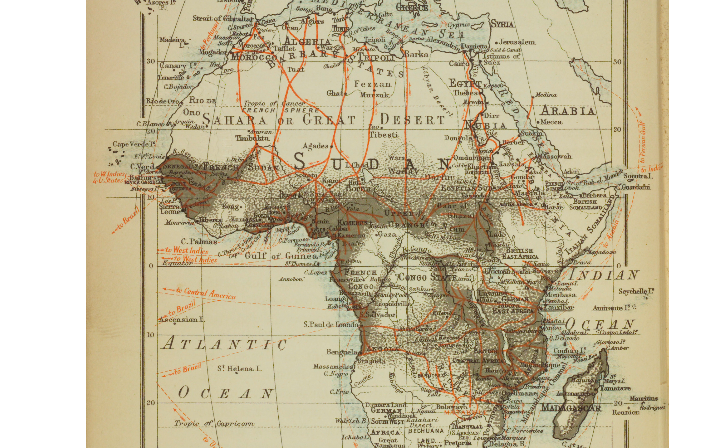
Geographically, the slave trade extended from Senegal inland along the Senegal River far inland, though in the southern areas of West Africa, trade did not penetrate very far. It existed most intensely in the regions 125 miles from the coasts. Rivers, roads, political systems, and trade networks influenced where slaves were sold. Because records were not kept in Africa, the texts of various missionaries in the Americas are used to reconstruct the geography of the slave trade. Trade was centered in mid-Africa (see map), but it was not consistent. Some kingdoms in the region did not engage in the slave trade while others stopped, or stopped and started again, for various political and reasons.
If the slave trade harmed Africa due to the tremendous loss of the population (50,000 a year at the height of the trade in the 1780s). Gender and labor relations shifted as more males were lost and females took over work that had been considered men’s domain. Why did it happen? Europeans did not have the power to capture slaves in Africa. They had to be bought from African traders. Why was this practice legal when it was so harmful to both regions and the continent? European commercial records indicate that the trade was controlled by the political and economic elites of Africa, who both taxed the sales and sold slaves directly. These rulers oversaw access to the coasts and could prevent the enslavement of their people if they so chose.
Thornton refutes (controversially) two major theses. One is that Africans sold slaves to gain access to the arms trade. The other is that Africans were dependent on Europeans for “vital, nonmilitary goods.” Because Africa was not a poor continent in the preindustrial period, Thornton argues, Africa had significant economic power, which allowed them to keep Europeans from capturing slaves and avoiding fees and taxes. This argument is expanded in detail.
Referring to missionary interviews with American slaves, Thornton examines how slaves were captured. Regularities in accounts feature the majority (e.g. two-thirds) were taken violently through kidnapping or as war captives. Others were sold by creditors or family members, and about five percent were sold as punishment by a court, and about five percent tricked into captivity through “treachery” (business associates, etc). Other accounts find a larger fraction of judicial enslavement, usually for debt or adultery.
Africa was politically organized into large and small states that were often at war. Defeated people were often killed or taken captive to be sold into the slave market. Most frequently, captives were not sold by their own people but a warring faction. Thornton argues African leaders were operating the same “fiscal military state” that Europe was, a zero-sum game that maximized profits for wars that consolidated state power.
Chapter 4: The American World, 1450-1700
Thornton emphasizes the wide variety of social organizations of indigenous societies in the Americans which determined the structure of the resulting American societies. Societies ranged from highly democratic small-scale groups with little social stratification to empires with strict bureaucracies that ruled millions. Thornton organizes these into free associations, or “egalitarian democracy,” marked by no formal government or permanent social class, and those with formal governments with a hierarchical state and social classes. These with formal states are divided again into mini-states (chiefdoms), with weak hierarchies, and imperial states, which were complex and inegalitarian. These divisions are functional and are often blurred in his analysis.
Throughout the text, Thornton argues against evolutionary trends in social science that view small, democratic societies as poor, primitive, “pre-state” or “backward remnants of ancient people who had failed to progress” (102) by noting that the standard of living for the average person in free associations may have surpassed Europeans of the same period.
Societies with egalitarian decision making were usually no larger than a few thousand people living in one or a few close settlements. Very little authority was permanently imposed on its people, yet societies lived with the welfare of the group in mind. Hierarchical societies generally exploit the average class members which pushes their standard of living below that of free association societies. “If one takes what people around the world today value as important in society, namely large-scale political participation and equality of incomes, then egalitarian democracies were the most advanced of their time.” While this is an interesting point, I am not sure how he concluded that people view equality as important, as this is a minority opinion. Many find income inequality entirely justified. That Thomas More and Michel de Montaigne used the system of egalitarian democracies as a base for their theories of political participation, however, is fascinating.
Examples of free-association people, such as the Island Caribs of the eastern Caribbean, who had classes and inequality; the Tupinambá of Brazil, The Iroquois and Huron of North America, who were similar to the Tupi in that their societies were loving and peaceful but their warfare with outsiders was brutal and vengeful; and the Mapuche of modern-day Chile.
Mini-state peoples included the Algonquin of North America, the Llanos of the Orinoco, the Tainos of the Carribbean, and the Zipa of Colombia.
The Mayans are classified as heirs of a disintegrated empire, the Mayapan, which fell around 1441 CE. The Spanish found Mayans living amongst the remnant of its great buildings, in various polities. Similarly, the remains of the Cahokia empire of the Mississippi Valley revealed a complex and socially stratified society that disintegrated from mini-states to free-associations by the time Europeans arrived.
The surviving imperial states of the Americas at the time of European arrival included the Aztecs of the Valley of Mexico, who used writing, and the Incas of the Andes. Both had complex taxation and trade that the Europeans were able to use to their advantage.
In areas of smaller states and free association, Europeans had to use vying groups as military allies (which they also did with fragmented groups of the American empires), or to enslave them for labor.
PART III: THE NATURE OF ENCOUNTER AND ITS AFTERMATH
Chapter 5: Conquest
Conquest requires a change of state, and as such requires a central authority who surrenders to another state, and whose subjects follow that dictate. Some states in the Americas surrendered to the Spanish. Only Angola in Africa was conquered by the Portuguese and Spanish. In these cases, the conquerors used the existing governments to manage the territories and very slowly phased in their own system of rule.
Thornton again pushes against the argument that Spain’s advanced military might was essential to their victory because they were far outnumbered and fighting in an unknown and sometimes severe ecology that their opponents knew well. Further, in some areas up to 90% of the native population was killed by diseases to which they had no resistance.
This leads to Thornton’s argument in this chapter: victor came not from military superiority, which helped, but from “substantial participation by Native American and African armies, who supplied the bulk of the soldiers with whom Spanish or Portuguese superiority was established.” These were largely through contracts of mercenary service. Cooperative allies had power to shape their roles in post-conquest landscape. Allied states, such as Tlaxcala, and groups such as the nobles of Cuzco, enjoyed tax and tribute exemptions.
Chapter 6: Colonization
When conquest was not worthwhile because there was no existing, profitable tax structure, Europeans turned to colonization. This occurs in uninhabited areas, such as Madeira and Azores in the early 15th century. Colonization also occurred in smaller states that could not defeat European invaders but did not collect enough taxes or surplus goods to make conquest attractive. Free associations also invited colonization, as many had no leader with the authority to surrender, and no taxes or surplus. The Portuguese in Brazil and northern Europeans largely expanded through colonization.
The colonization of societies with free association brought problems with military affairs and finding labor to create wealth for the charter or crown. If crops brought wealth, such as sugar, the colony was highly unequal and socially stratified, often with an African underclass. Without a lucrative product, race and class distinctions were smaller and the government more democratic. In North America, however, where settlers arrived in family groups, democratic government was high but so was racial distinction. Where settlers were only male, racial differences were fewer because elite men married into the existing indigenous elite and had mixed children who usually spoke the indigenous language.
Chapter 7: Contact
When one region could not subdue another, or when colonization was slow enough that frontiers were established, as in much of North America, cultures came into prolonged contact with cultural and political exchange between equal partners. Along the African coast, Europeans established trading systems with African states. With the exception of Portuguese Angola and the colonization of South Africa, the African encounter was largely contact.
Europeans could not conquer the state-organized societies of Africa, yet in America, most state-organized societies were conquered early on by Portugal and Spain, aside from small states of the Maya and along the Orinoco and Amazon rivers. The Incas, Aztecs, the Chesapeake, and the Massasoit societies were conquered fairly quickly, but the free-association societies that remained took centuries to subdue, as when they were defeated, they retreated and moved their homes. This created frontiers of cultural interaction in which indigenous Americans learned about European culture, politics, and warfare. Thornton examines how cultures all over the Americans were able to fend off Europeans until the late 19th century. Where it has been assumed that free associations were the weakest social structures, their egalitarian cultures and mobility (with no great riches to protect) made them a difficult conquest.
PART IV: CULTURE TRANSITION AND CHANGE
The interaction of people from thousands of societies from the four continents of the Atlantic World created unique social products and practices. Some people moved to entirely new home environments, while others stayed an interacted with newcomers. Thornton sorts the cultural change into the categories of hard, which are difficult to change and tend to break, such as language. Soft elements of culture change easily and quickly and benefit from new ideas, such as aesthetics like art and music. In between, he places religion, worldview, and philosophy, which are difficult but able to be changed if done within the system.
In addition to hard and soft elements of culture, the preservation of communities during popular transfer is key. Northern Europeans who moved freely with their families kept much of their original culture, whereas the violent transfer of slaves did little to preserve community and therefore, culture.
Chapter 8: Transfer and Retention in Language
Thornton uses the colonization of North America as a model for language survival in immigration. English and French colonists kept their languages whereas Danish, Dutch, German, and Swedish colonists lost their languages over generations as younger generations were first bilingual, and then eventually monolingual, as English was the lingua franca. An exception is the Amish of Pennsylvania who interacted little with surrounding communities and intentionally kept their culture as strictly as possible.
In areas that were conquered such as the Aztecs or Incas, their languages survived as the communities survived. Yet over generations, their languages followed similar patterns outlined above. If business came to be conducted in Spanish, and if rural people moved to cities for work, often their children would be bilingual and their grandchildren monolingual Spanish speakers.
In places that conquest did not involve women settlers, elite men married elite American or African women who often preserved the native language for their children, which the Spanish and Portuguese also spoke. This sometimes led to the native language being dominant rather than that of the conqueror. In these cases, other aspects of culture would remain more intact as well.
Another pattern was the adoption of a lingua franca for communities that were displaced, particularly in North America. Often Native Americans did not know their neighbor’s language, but one member of their society would learn their allies language and be the translator. This changed as movement west pushed many tribes together, they adopted the language of the dominant group, such as Algonquin or Iroquois.
Africans lost their languages in America due to community dissolution, and second-generation slaves would often become bilingual in a creole with the colonial base language which Thornton argues was developed through trade on the coast of Africa rather than in the Americas. Most languages were lost over generations as the dominant language took over.
Chapter 9: Aesthetic Change
Thornton explains that the concept and creation of beauty is universal and mark humans as a unique species, though aesthetic values between classes and cultures differ. Aesthetics are a soft and fluid form of culture which change easily and often positively when exposed to outside influences.
Because of its durability, pottery is a well-examined remnant of aesthetic decoration, and Thornton reviews the cultural changes in elite and non-elite pottery of various cultures, as well as the various pressures on fashion change, such as religion and the influence of European elites on colonial elites.
In Africa, elites worn their own clothing or mixed it with European suits and accessories, at least when meeting Europeans. Indigenous Americans adapted their own traditional fashion to European textiles and European men often adopted elements of Indian dress, though women did not. Music is analyzed through the elements of patronage, virtuosity, elite and folk styles, and the new forms that came to be. The aesthetic mixing of cultures is the most dynamic form of cultural exchange and account for the popularity of American culture around the world.
This chapter, while interesting, begins to make Thornton’s vast synthesis and comparative analysis seem selective and arbitrary. Perhaps I’m tiring of the style of the book, as others liked this section most.
Chapter 10: Religious Stability and Change
Religion is neither soft nor hard in Thornton’s schema, but in the middle. It is flexible to change without breaking, but requires the change of beliefs, which requires time. Indeed, Christianity became the major religion of the Americas by 1800, but only had minor inroads in Africa. What all religions of the Atlantic basin had in common was a belief in the “Other World, a normally invisible sphere that coexisted with but dominated This World, which is the material sphere we all live in.” The existence of the other world was not directly known to humans.
Thornton grounds this chapter in the religious unrest in Europe in the period of exploration, inspired by the Reformation of 1517. He writes a summary of religious change in Europe, African and the Americas based on revelations which he (unsurprisingly) categorizes into two types: discontinuous and continuous. Discontinuous revelations are vast and rich, delivered infrequently, with information on how entire peoples should live. They provide the material for the great books of the Talmud, the Bible and the Qur’an and were received by only a few people. Continuous revelations are valuable to one or a few rather than a community unless they occue within an established religion. These are the revelations of fortune tellers, astrologers, apparitions, spirit-mediums, and witches. Indeed most types of continuous revelations were condemned by the Christian church and labeled demonic. Questions of authority in Christianity drove politics strife and wars in Europe, which reverberated throughout the Americas. Christian missionaries were successful in converting much of the Americas, however the practices created on the ground were an amalgamation on indigenous beliefs blended with Christian to suit the needs of each community, and example of which we saw in Linford Fisher’s The Indian Great Awakening. Co-revelation was a dynamic part of this process that was sometimes denounced by religious leaders, but religious practices merged nonetheless.
Chapter 11: The Revolutionary Moment in the Atlantic
In his final chapter, Thornton reviews the Revolutions that pushed back the Europeans in the age between the American Revolution in 1775 to the Spanish American Revolutions in 1825.
By the 1700s, all European colonial countries maintained a “military-fiscal state,” which Thornton first discussed in the struggles between the monarchy and noble class in Portugal in the 14th and 15th centuries. European militaries were increasingly expensive, and courts could not tax nobles, church bodies, many corporate entities, towns, and provinces had privileges that limited their taxation. The richest of Europe were essentially untaxed, the kings were reluctant to change this, and so the burden fell on commoners. The sheer unfairness of this system was obvious and widely criticized. “French economic thinkers, often drawn from that class, constantly reminded the kings that huge untapped revenues awaited them in the privileges of the nobles and the church.”
The revolutionary spirit that swept America and Europe was championed by the middle-class merchant elites who were burdened by royal taxation. Monarchies of the era of expansion (early modern Europe) were funded by taxation systems that exempted the church and nobility while new commercial elites were unprotected and unable to buy nobility. In the Americas almost no one could avoid taxation, and monopolies favored metropolitan merchants. The republican Enlightenment of late-1700s Europe looked to write “rational” tax policy that would be applied more evenly and make the rulers accountable to their funders, the taxpayers.
Merchant elites in the Americas came together to fight these taxes, and eventually the British, hoping that the lower classes who helped fight would not make their own demands of fairness beyond taxation. Thornton provides a survey of American revolutions from the U.S., New Granada (now Colombia), the French and Haitian Revolutions, South America, Mexico, and Brazil. These revolutions for independence were won through a fight between interrelated elites, and no side clearly won. These wars were partially civil wars. The marginalized and the lower classes played a large part in most of these revolutions, especially in Haiti, and they won a small amount of freedom and power. How the new governments would manage the demands of these groups, who, it was hoped by elites, would not significantly gain from these wars of freedom, is a question these governments still struggle with today.
HISTORIOGRAPHY:
Eric Hinderaker and Rebecca Horn, “Territorial Crossings: Histories and Historiographies of the Early Americas,” William and Mary Quarterly, 3rd series, 57 (2010): 395–432, https://doi.org/10.5309/willmaryquar.67.3.395.
CATEGORIES: Cultural and Social History, Native American Religion, Great Awakening, Early U.S. History, Colonial U.S., Native American History, New England History, Southeastern New England.
PLACE: Southeastern New England and eastern Long Island.
TIME PERIOD: 1700-1820.
TAKEAWAY: The Indian Great Awakening in the northeastern US was not one of wholehearted conversion but a complex engagement with Christianity.
SUMMARY:
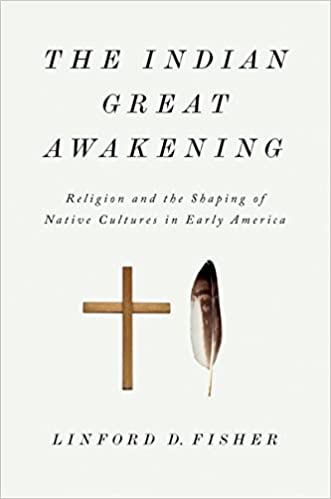
Linford Fisher’s The Indian Great Awakening (2012) revises twentieth-century narratives about Indians’ wholesale conversions to Christianity in eighteenth-century New England. Fisher interrogates the 1899 history book Samson Occom and the Christian Indians of New England by William DeLoss Love to argue for the complexities of Native Americans’ experiences with Christianity in Connecticut, Rhode Island, and eastern Long Island. Love’s primary sources (Occom’s diaries, letters, and manuscripts) are plumbed, as well as some new sources.
Rather than trumpeting Indians’ “conversions” to Christianity (a Eurocentric concept), Fisher demonstrates the subtleties of their “engagement” with the Christian beliefs that were embedded in colonial interactions, often inspired by desires to retain their land and autonomy. With a focus on Native Americans’ agency, Fisher examines how various Indian communities engaged, affiliated with, “debated, considered, enacted, adapted, and even retracted” Christian belief over generations. Indians did not reject their own native spiritual beliefs to accept Christianity. Instead, they “tested, sampled, and appended” new practices to those they already engaged.
Fisher traces Native experiences with Christianity in this region from the “second wave” of evangelism in the early eighteen century, which included education for Indians. Because they understood the political advantages of education, Indians engaged missionaries on their lands and in their schools. Internal political battles over these practices caused problems, as did internal struggles about land. Fisher suggests that Natives were not interested in Christianity so much as the education for children that missionaries provided.
The participation of Indians in the revivals of the Great Awakening of the 1730s and 1740s is “arguably” the most misunderstood aspect of their lives in this region and period, Fisher posits. These much-studied revivals tended to empower lay people, including groups excluded from the ministry like women, Indians, and Blacks. This spiritual empowerment destabilized traditional (and often very strict) churches and inspired separatist churches. Fisher addresses the Native separatist church movement run by unlicensed Indian ministers which has been mentioned by other historians but not explored. This movement is detailed in the second temporal phase of the text from 1740 to 1750.
Indians also participated in white churches. Instead of “wholesale conversion,” Native Americans engaged with everything from indifference to (yes) conversion. Historians have focused on the conversions, baptisms, and other shows of faith, however many and sometimes most Natives were entirely absent from church records. Those who did practice Christian customs did not necessary remain engaged, and sometimes turned to Indian-run Separate Churches. “Indian Separatism was a thriving, largely underground, post-Awakening movement that provided several decades of cultural connectivity and intertribal fellowship for Christian subsets of Native communities.” This was not what the English had in mind.
Chapter one, “Rainmaking,” is a brief introduction to the region to 1725, by which time English colonists outnumbered Indians by about fifteen to one in Connecticut. From the journey over the Bering Strait to the voyage of Giovanni Verrazano, the basics are covered for a reader not familiar with early American history. The importance of land to both Indians and English colonists is discussed, as well as seventeenth-century evangelism. Because warfare, disease, and displacement killed so many Indians, by 1700, they lost much of their political power, land, and autonomy. Even so, they retained their culture and customs by taking them underground.
In chapter two, “Evangelizing,” Fisher revises the argument that Natives were averse to Christianity until the Great Awakening of the 1730s and 1740s by extending the period of their affiliations with Christianity and demonstrating its complexity. In the 1720s, he argues, the continued evangelization by the English (which he terms, the “second wave”) combined with Indians actively pursuing education, brought about conflict within native families and communities, as some were opposed to “something as seemingly innocuous as receiving basic education in the English language” (36).
In Fisher’s opening example, the Native matrons were against “education” and the males were in favor. [Aside: juxtapose the words “matron” and “patron.” Ah, I see.] Education “for their children [became] an attractive option for some families, opportunities that were almost always sweetened by the material benefits and potential political alliances that education, schoolteachers, and sponsoring societies brought. Such religious and cultural decisions were embedded within a larger lived reality of cultural engagement, adaptation, and accommodation that included ideas about labor, land dispossession, kinship, and strategies for survival” (36). Differences in accommodation to English customs caused damaging political rifts in Indian communities.
Central to Fisher’s historical revision: Indians wanted education, not conversion to Christianity—a “Eurocentric concept.” Yet to argue that Indian children were not educated because they were not taught to read and write in schools is equally Eurocentric. This definition of “educate” dates only from 1610. Previously, it meant to bring up children generally, and most certainly Indians had their own knowledge traditions that were taught to children. It is also interesting that he pushes a gendered narrative of who desired European education. For Fisher, it is noble to desire one’s children be educated in the business, politics, and written culture of Europeans, but not their religion. The tone Fisher takes is not condescending and reflects various nuances of Indians’ impetus to seek or reject European education. His argument is less Eurocentric than that of wholesale conversion to Christianity only because he accounts for nuances of what is accepted and rejected—though he largely speaks to what is engaged in aspects of Christianity rather than the colonizers’ attitudes toward land, business, and materialism.
Fisher also argues in this chapter that Natives were particularly suspicious of Christianity because the religion of those stealing their land and the religion of the missionaries were one. Because religious belief was intertwined with all facets of Native life and worldview, land and religion were not separable (though one might argue the same of the colonizers’ Manifest Destiny). As the Indians lost more and more land, they increasingly lost trust in Christianity, as it had not helped them maintain their autonomy.
Chapter three, “Awakening,” reiterates in detail that the Great Awakening of the 1740s was a “continuation of, not a break with, prior religious engagement and strategies of creative cultural and religious adaptation and survival (67).” The experience of the Awakening is explored in the Indian communities of the Mashantucket and Lantern Hill Pequots, Niantics, Mohegans, Montauks and Shinnecocks, Narragansetts, and Pachgatgochs.
Chapter four, “Affiliating,” documents through baptismal and membership church records the affiliation of Natives with white churches during the Awakening. The affiliations rose in the 1730s, spiked in 1741-1742 fell sharply thereafter. As such the affiliations were less common and of less duration than has previously been assumed. Fisher generally plays down Indian involvement in the Great Awakening.
Chapter five, “Separating,” describes how Indian communities left the revivals of the Awakening and built Separate churches of unofficial Indian teachers, preachers, and worshipers in the 1750s and 1760s. Samson Occom, who was not a Separatist minister but often functioned as one, Samuel Ashpo, and Samuel Niles are featured as Indian ministers who led Separatist congregations. These churches tended to pick and choose what Christian beliefs and practices were useful to them while still attending to aspects of their Native spiritual customs which gave Native Christianity a unique form.
Chapter six, “Educating,” explores how Natives dismissed the religious oversight of Christian missionaries and insisted on control over their churches and education in the 1760s. This struggled intersected with the larger issues of autonomy, culture, and land rights. Fisher argues that Native schools were attended in far greater numbers than Eleazar Wheelock’s Indian Charity School, which has received undo attention in historical scholarship.
Chapter seven, “Migrating,” surveys the problems and varied solutions sought by Natives in the region in the 1770s. A literate group of Native Christians from various tribes and led by the minister Samuel Occom planned a migration to the new Brotherhood community in the Oneida region of New York. Because these migrants were literate, they have received more attention than their size warrants, as most Indians of Southeast New England stayed home and fought increasing intrusion on their culture and land. The first migration just before the Revolutionary War was small. The second, in 1885, was more successful, but still a minority of the areas Natives. The chapter also covers Indians and the Revolutionary War. While many young men died fighting, the Indians’ lands were untouched.
Coming full circle, chapter eight, “Remaining,” opens in 1809, with a new missionary effort by Protestants toward the Narragansetts. The Natives who did not leave for Brotherton (the vast majority) stayed back to advocate for themselves in various ways, while still others migrated to other locations. New movements of resistance to colonization were formed as Indians fought to retain their traditions.
The “Epilogue” features a tour of four present-day Native churches in the region and shares some of their history as well as current status. Fisher reiterates his point, “the story of New England native religious engagement between 1700 and 1820 and beyond is far more complex and nuanced than the framework of ‘religious conversion’ can effectively or actively capture.”
Mills, Kenneth, and Anthony Grafton, eds. Conversion: Old Worlds and New. Studies in Comparative History. Rochester, NY: University of Rochester Press, 2003.