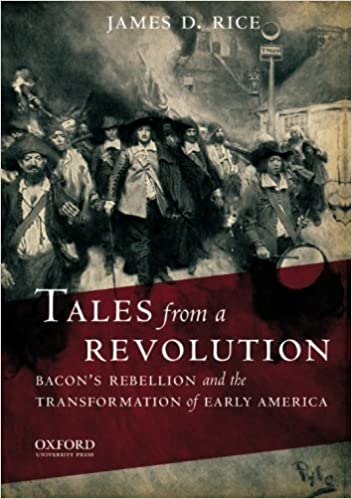
Rice, James D. Tales from a Revolution: Bacon’s Rebellion and the Transformation of Early America. New Narratives in American History. New York: Oxford University Press, 2012.
CATEGORIES: Early U.S. History, Colonial U.S., Native American History, Virginia and Maryland History, Insurrections, Bacon’s Rebellion, 1676.
PLACE: Virginia, Maryland, North Carolina, New York.
TIME PERIOD: 1675-1725.
SUMMARY:
James D. Rice’s short revisionist narrative of Bacon’s Rebellion and the following decades provides a new but familiar thesis—he is unable to support, particularly in such a short book. The synthesis history of the rebellion itself is an enjoyable read, as is the aim of the “New Narratives in American History” series from Oxford University Press, but the entire second part of the book concerns an argument about anti-Catholic conspiracy, which seems strange to a colony known for its irreligion. While Rice builds on Morgan’s American Slavery, American Freedom, he omits pivotal facts from Morgan’s thesis to ultimately argue that were it not for those poor, racist white populists, Native Americans would be thriving in the United States today.
Rice explains in the Afterward that his narrative style precludes a traditional academic thesis, but has allowed him to write in a way that readers must think for themselves about events in order to discover the truth of his thesis, which he spells out at the end of the book. I recommend reading this at the beginning.
The Afterward begins with a valuable historiography that explains the various turns the narrative of Bacon’s Rebellion has taken, before a segue to the benefits and pitfalls of narrative history. Next he hits on a sub thesis, closely related to his main argument, which echoes loudly in 2022. Reliable information was hard to come by for 17th-century Virginians, who “made their choices in the absence of information, operating within what is often called the “fog of war—which, as the great Prussian military theorist Carl von Clausewitz described it, “gives to things exaggerated dimensions and an unnatural appearance.” The unreliable stories of Sarah Grendon, Thomas Mathew, and Nathaniel Bacon indicate that “gossip, rumor, misinformation, and contending stories,” the “wild, irrational tales, full of paranoia, supernatural forces, superheated rhetoric, and outright misinformation” ruled the day (209). It’s telling that Rice does not include Berkeley in his list of unreliable narrators, for, while he concedes that Berkeley was corrupt and had little concern for the frontiersmen whose lives buffered the wealthy planters from the Indians, he believes that Berkeley was in the right. The belief in the supernatural was (and arguably still is, outside of academia, in all social classes) commonplace in this era was well established by historians such as David D. Hall.
The rebellion was caused by the settlers’ “fear, anger, and suspicious-mindedness; their paranoia and susceptibility to conspiracy theories; their vengefulness and malice; and their willingness to resort to violence, savagery, oppression, and cruelty when they felt threatened by Indians, governors, “Papists,” or anyone else outside their tribe.” Ah yes, those poor, tribal whites. Never mind the violence, savagery, oppression, and cruelty of the governors and the assemblies in their never-ending pursuit of profits. Never mind that poor, white indentured servants rebelled side-by-side with Black slaves. And never mind that the poor whites forced to the edges of the frontier by elites were frequently victims of Indians “violence, savagery, and cruelty” when the wealthy ruling class pushed them off their land.
To believe Rice’s argument requires forgetting, or ignoring, that Berkeley, long-known as an diplomat par excellence to his Indian trading allies, thirty years previous had forced the Powhatans off their land around Jamestown, killed their chief, and almost obliterated the tribe of over 10,000, by far the largest of the area. After subduing the tribe he engaged them in fur, skins, and Indian slave trade. Confusing a wish to protect his financial interests with a special concern for Indian rights is dubious and buys into a “good Indian, bad Indian” narrative (see Thornton). What his and other texts demonstrate is that white English elites used Indians when it served them and turned on them when it did not. That we are to believe that wealthy colonists did not take lands from the Indians when it suited them and when they could, that instead it was the fault of the “savage, superstitious, tribal” poor white populists is quite a fantastic thesis. But it does serve a certain political position and psychological viewpoint—that racism is the fault of racist, “tribal,” poor whites over there, rather than baked into the systems and psychology of the United States. As Morgan suggested, racism serves elites today as well as it did in 1676.
More welcome in Rice’s analysis is his inclusion of Indians’ experiences during this period. He details how English gentlemen pushed Indians westward and southward, as did the powerful Five Nations Iroquois of the mid-Atlantic region. Tribes that migrated had to negotiate with tribes already inhabiting those areas, who often used different languages. These negotiations often turned into wars, and larger tribes subsumed others as more and more Indians were dislocated.
In Part Two of the book, Rice argues that Bacon’s rebellion was not a short period of insurrection led by the notorious Bacon. Instead it was a series of rebellions caused by various political alliances and the displacement of Indians. In Rice’s telling, Bacon’s Rebellion was not against corrupt royal authority but against authority that would not remove frontier Indians’ from their lands. Rice suggests this is because of white tribal racism, ignoring the facts that the elites intentionally restricted freed servants’ access to land to decrease their power and increase the value of the elites’ land. Nor did the government seek to protect the poor whites on the frontiers who were often killed by Indians seeking revenge on actions taken by government officials. We are not asked to consider why, exactly, poor men brought, often by force, to settle and work in servitude in a faraway land with shocking morbidity rates, might be angry.
Instead we are told that the Baconites were summoned by a tract called “A Complaint from Heaven with a Huy and crye and a petition out of Virginia and Maryland ” written anonymously late in 1676, before the rebellion had been squashed. It called for a continuation of the rebellion due to Lord Baltimore’s mistreatment of his people through his alliances with Indians. He was against the people because he was a papist Catholic in alliance with Indians and the French in Canada, who were drawing closer and closer to Virginia. Bacon’s Rebellion, Rice argues, was not against royal authority but against Catholicism and the threat of Louis XIV. They continued to rebell in the 1680s and followed closely the Glorious Revolution, believing a Protestant king would serve their interests. Indeed, when William III claimed the throne in 1889 he placed Francis Nicholson as royal governor. Nicholson allegedly followed the desires of the Baconites and henceforth used broadstroke anti-Indian policies. It was not because trade with Indians for skins and Indian captives was, by the 1690s, no longer enticing for the elites, but because of the desires of the racist rabble.
The connections between Bacon’s Rebellion, the Glorious Revolution, and Coode’s Rebellion are unclear. Though Rice elaborates in his afterward, there is simply not enough evidence presented to make the connections believable. While his independent analyses carry weight, that they are all bound up together is problematic. While he asks at the end, “What if Bacon had died young?,” suggesting that perhaps Indians would have prospered under more Berkeleys and Baltimores, I was instead convinced that given the numerous uprisings before and after Bacon, and the elites’ need to control the exploited poor, and the shifts in Indian economies, these trends would have developed with or without that particular sorry rebel.
HISTORIOGRAPHY
Beverly Robert. History and Present State of Virginia, London: R. Parker, at the Unicorn, under the Piazza’s of the Royal-Exchange, 1705.
Morgan, Edmund S. American Slavery, American Freedom: The Ordeal of Colonial Virginia. New York: W.W. Norton & Co, 2003.
Washburn, Wilcomb E. The Governor and the Rebel: A History of Bacon’s Rebellion in Virginia. Chapel Hill: University of North Carolina Press, 1957.
Webb, Stephen Saunders. 1676, the End of American Independence. New York: Knopf, 1984.
Wertenbaker, Thomas Jefferson. Torchbearer of the Revolution: The Story of Bacon’s Rebellion and Its Leader. Princeton: Princeton University Press, 1940.
Wilson, J. The History of Bacon’s and Ingram’s Rebellion in Virginia, in 1675 and 1676. Cambridge, Mass, J. Wilson Press, 1867.