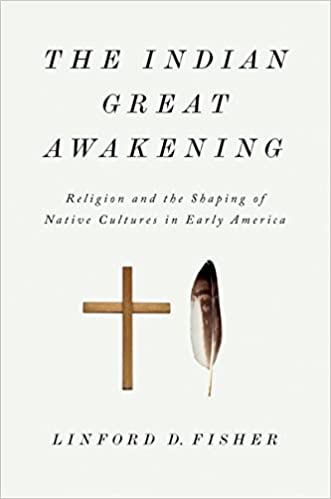
Fisher, Linford D. The Indian Great Awakening: Religion and the Shaping of Native Cultures in Early America. Oxford; New York: Oxford University Press, 2012.
CATEGORIES: Cultural and Social History, Native American Religion, Great Awakening, Early U.S. History, Colonial U.S., Native American History, New England History, Southeastern New England.
PLACE: Southeastern New England and eastern Long Island.
TIME PERIOD: 1700-1820.
TAKEAWAY: The Indian Great Awakening in the northeastern US was not one of wholehearted conversion but a complex engagement with Christianity.
SUMMARY:
Linford Fisher’s The Indian Great Awakening (2012) revises twentieth-century narratives about Indians’ wholesale conversions to Christianity in eighteenth-century New England. Fisher interrogates the 1899 history book Samson Occom and the Christian Indians of New England by William DeLoss Love to argue for the complexities of Native Americans’ experiences with Christianity in Connecticut, Rhode Island, and eastern Long Island. Love’s primary sources (Occom’s diaries, letters, and manuscripts) are plumbed, as well as some new sources.
Rather than trumpeting Indians’ “conversions” to Christianity (a Eurocentric concept), Fisher demonstrates the subtleties of their “engagement” with the Christian beliefs that were embedded in colonial interactions, often inspired by desires to retain their land and autonomy. With a focus on Native Americans’ agency, Fisher examines how various Indian communities engaged, affiliated with, “debated, considered, enacted, adapted, and even retracted” Christian belief over generations. Indians did not reject their own native spiritual beliefs to accept Christianity. Instead, they “tested, sampled, and appended” new practices to those they already engaged.
Fisher traces Native experiences with Christianity in this region from the “second wave” of evangelism in the early eighteen century, which included education for Indians. Because they understood the political advantages of education, Indians engaged missionaries on their lands and in their schools. Internal political battles over these practices caused problems, as did internal struggles about land. Fisher suggests that Natives were not interested in Christianity so much as the education for children that missionaries provided.
The participation of Indians in the revivals of the Great Awakening of the 1730s and 1740s is “arguably” the most misunderstood aspect of their lives in this region and period, Fisher posits. These much-studied revivals tended to empower lay people, including groups excluded from the ministry like women, Indians, and Blacks. This spiritual empowerment destabilized traditional (and often very strict) churches and inspired separatist churches. Fisher addresses the Native separatist church movement run by unlicensed Indian ministers which has been mentioned by other historians but not explored. This movement is detailed in the second temporal phase of the text from 1740 to 1750.
Indians also participated in white churches. Instead of “wholesale conversion,” Native Americans engaged with everything from indifference to (yes) conversion. Historians have focused on the conversions, baptisms, and other shows of faith, however many and sometimes most Natives were entirely absent from church records. Those who did practice Christian customs did not necessary remain engaged, and sometimes turned to Indian-run Separate Churches. “Indian Separatism was a thriving, largely underground, post-Awakening movement that provided several decades of cultural connectivity and intertribal fellowship for Christian subsets of Native communities.” This was not what the English had in mind.
Chapter one, “Rainmaking,” is a brief introduction to the region to 1725, by which time English colonists outnumbered Indians by about fifteen to one in Connecticut. From the journey over the Bering Strait to the voyage of Giovanni Verrazano, the basics are covered for a reader not familiar with early American history. The importance of land to both Indians and English colonists is discussed, as well as seventeenth-century evangelism. Because warfare, disease, and displacement killed so many Indians, by 1700, they lost much of their political power, land, and autonomy. Even so, they retained their culture and customs by taking them underground.
In chapter two, “Evangelizing,” Fisher revises the argument that Natives were averse to Christianity until the Great Awakening of the 1730s and 1740s by extending the period of their affiliations with Christianity and demonstrating its complexity. In the 1720s, he argues, the continued evangelization by the English (which he terms, the “second wave”) combined with Indians actively pursuing education, brought about conflict within native families and communities, as some were opposed to “something as seemingly innocuous as receiving basic education in the English language” (36).
In Fisher’s opening example, the Native matrons were against “education” and the males were in favor. [Aside: juxtapose the words “matron” and “patron.” Ah, I see.] Education “for their children [became] an attractive option for some families, opportunities that were almost always sweetened by the material benefits and potential political alliances that education, schoolteachers, and sponsoring societies brought. Such religious and cultural decisions were embedded within a larger lived reality of cultural engagement, adaptation, and accommodation that included ideas about labor, land dispossession, kinship, and strategies for survival” (36). Differences in accommodation to English customs caused damaging political rifts in Indian communities.
Central to Fisher’s historical revision: Indians wanted education, not conversion to Christianity—a “Eurocentric concept.” Yet to argue that Indian children were not educated because they were not taught to read and write in schools is equally Eurocentric. This definition of “educate” dates only from 1610. Previously, it meant to bring up children generally, and most certainly Indians had their own knowledge traditions that were taught to children. It is also interesting that he pushes a gendered narrative of who desired European education. For Fisher, it is noble to desire one’s children be educated in the business, politics, and written culture of Europeans, but not their religion. The tone Fisher takes is not condescending and reflects various nuances of Indians’ impetus to seek or reject European education. His argument is less Eurocentric than that of wholesale conversion to Christianity only because he accounts for nuances of what is accepted and rejected—though he largely speaks to what is engaged in aspects of Christianity rather than the colonizers’ attitudes toward land, business, and materialism.
Fisher also argues in this chapter that Natives were particularly suspicious of Christianity because the religion of those stealing their land and the religion of the missionaries were one. Because religious belief was intertwined with all facets of Native life and worldview, land and religion were not separable (though one might argue the same of the colonizers’ Manifest Destiny). As the Indians lost more and more land, they increasingly lost trust in Christianity, as it had not helped them maintain their autonomy.
Chapter three, “Awakening,” reiterates in detail that the Great Awakening of the 1740s was a “continuation of, not a break with, prior religious engagement and strategies of creative cultural and religious adaptation and survival (67).” The experience of the Awakening is explored in the Indian communities of the Mashantucket and Lantern Hill Pequots, Niantics, Mohegans, Montauks and Shinnecocks, Narragansetts, and Pachgatgochs.
Chapter four, “Affiliating,” documents through baptismal and membership church records the affiliation of Natives with white churches during the Awakening. The affiliations rose in the 1730s, spiked in 1741-1742 fell sharply thereafter. As such the affiliations were less common and of less duration than has previously been assumed. Fisher generally plays down Indian involvement in the Great Awakening.
Chapter five, “Separating,” describes how Indian communities left the revivals of the Awakening and built Separate churches of unofficial Indian teachers, preachers, and worshipers in the 1750s and 1760s. Samson Occom, who was not a Separatist minister but often functioned as one, Samuel Ashpo, and Samuel Niles are featured as Indian ministers who led Separatist congregations. These churches tended to pick and choose what Christian beliefs and practices were useful to them while still attending to aspects of their Native spiritual customs which gave Native Christianity a unique form.
Chapter six, “Educating,” explores how Natives dismissed the religious oversight of Christian missionaries and insisted on control over their churches and education in the 1760s. This struggled intersected with the larger issues of autonomy, culture, and land rights. Fisher argues that Native schools were attended in far greater numbers than Eleazar Wheelock’s Indian Charity School, which has received undo attention in historical scholarship.
Chapter seven, “Migrating,” surveys the problems and varied solutions sought by Natives in the region in the 1770s. A literate group of Native Christians from various tribes and led by the minister Samuel Occom planned a migration to the new Brotherhood community in the Oneida region of New York. Because these migrants were literate, they have received more attention than their size warrants, as most Indians of Southeast New England stayed home and fought increasing intrusion on their culture and land. The first migration just before the Revolutionary War was small. The second, in 1885, was more successful, but still a minority of the areas Natives. The chapter also covers Indians and the Revolutionary War. While many young men died fighting, the Indians’ lands were untouched.
Coming full circle, chapter eight, “Remaining,” opens in 1809, with a new missionary effort by Protestants toward the Narragansetts. The Natives who did not leave for Brotherton (the vast majority) stayed back to advocate for themselves in various ways, while still others migrated to other locations. New movements of resistance to colonization were formed as Indians fought to retain their traditions.
The “Epilogue” features a tour of four present-day Native churches in the region and shares some of their history as well as current status. Fisher reiterates his point, “the story of New England native religious engagement between 1700 and 1820 and beyond is far more complex and nuanced than the framework of ‘religious conversion’ can effectively or actively capture.”
HISTORIOGRAPHY:
Anderson, Emma. The Betrayal of Faith: The Tragic Journey of a Colonial Native Convert. Harvard Historical Studies 160. Cambridge, Mass: Harvard University Press, 2007.
Brooks, Joanna. American Lazarus: Religion and the Rise of African-American and Native American Literatures. Oxford ; New York: Oxford University Press, 2003.
Bross, Kristina. Dry Bones and Indian Sermons: Praying Indians in Colonial America. Ithaca, N.Y. ; London: Cornell University Press, 2004.
Cogley, Richard W. John Eliot’s Mission to the Indians before King Philip’s War. Cambridge, Mass: Harvard University Press, 1999.
Love, William DeLoss. Samson Occom and the Christian Indians of New England. Chicago: Pilgrim Press, 1899.
Mandell, Daniel R. Behind the Frontier: Indians in Eighteenth-Century Eastern Massachusetts. Lincoln: University of Nebraska Press, 1996.
Martin, Joel W., and Mark A. Nicholas, eds. Native Americans, Christianity, and the Reshaping of the American Religious Landscape. Chapel Hill: University of North Carolina Press, 2010.
Mills, Kenneth, and Anthony Grafton, eds. Conversion: Old Worlds and New. Studies in Comparative History. Rochester, NY: University of Rochester Press, 2003.
Silverman, David J. Red Brethren: The Brothertown and Stockbridge Indians and the Problem of Race in Early America. Ithaca, N.Y: Cornell University Press, 2010.
Vilaça, Aparecida, and Robin Wright, eds. Native Christians: Modes and Effects of Christianity among Indigenous Peoples of the Americas. Vitality of Indigenous Religions Series. London: Routledge, 2016.
Wheeler, Rachel M. To Live upon Hope: Mohicans and Missionaries in the Eighteenth-Century Northeast. Ithaca: Cornell University Press, 2008.
Wyss, Hilary E. Writing Indians: Literacy, Christianity, and Native Community in Early America. Native Americans of the Northeast. Amherst: University of Massachusetts Press, 2000.