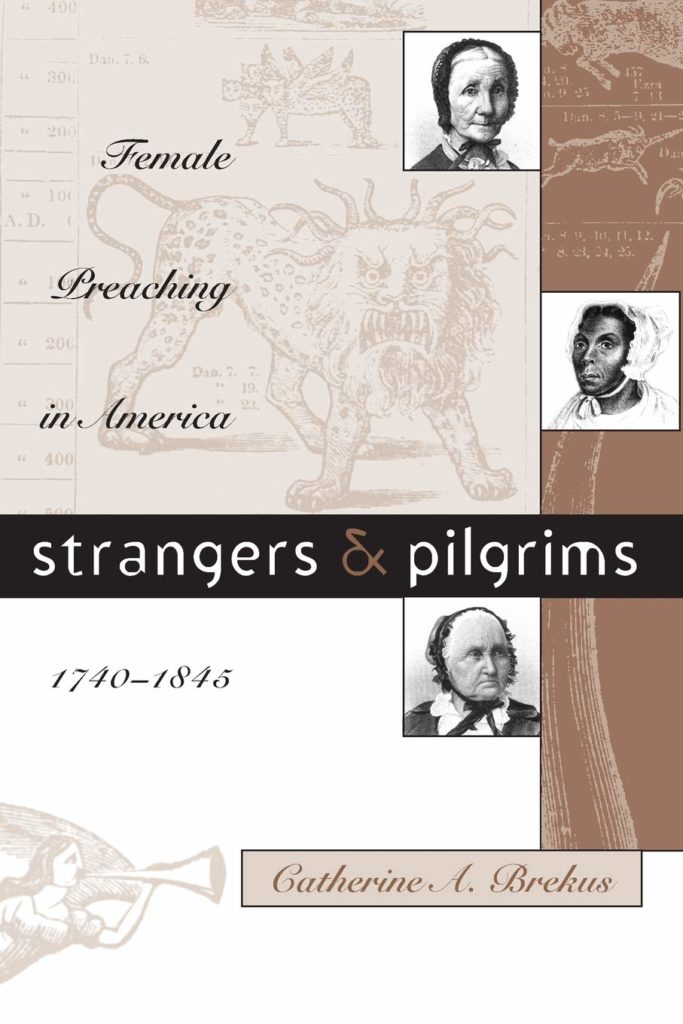
Brekus, Catherine A. Strangers and Pilgrims: Female Preaching in America, 1740-1845. Chapel Hill, N.C.; London: University of North Carolina Press, 1998.
CATEGORIES: Cultural and Social History, American Religion, Great Awakening, Early U.S. History, Women’s History, Women in Christianity
PLACE: Eastern Colonies/U.S.
TIME PERIOD: 1740-1845.
SUMMARY:
Introduction: Recovering the History of Female Preaching in America
In Strangers and Pilgrims: Female Preaching in America, Catherine Brekus explores the lives of forgotten women preachers of 1740-1845 America. Though she first assumed these women would be for women’s rights, she found that they were “biblical” rather than secular feminists (though the term post-dates the era) who “based their claims to female equality on the grounds of scriptural revelation, not natural rights.” As such, they did not seek ordination or institutional power, but acted as men’s assistants while also preachers in their own rights.
Why these women were forgotten is a central question for Brekus. The eighteenth-century women were forgotten because they were too orthodox in their theology for later feminists, and too radical in their beliefs and behavior to be remembered by evangelicals. Because the stories of more than one hundred women who preached were largely lost, they were difficult for Brekus to recreate, often the only narratives being in the notes of hostile male preachers who eventually wished to silence them. Their deviance led them to feel like exiles or pilgrims in their own land. Brekus uncovers their stories in order to reexamine our assumptions about the history of women and religion in the U.S.
Nineteenth-century women preachers differed from eighteenth as cultural mores and theology shifted. These women left behind memoirs and religious tracts, and they defended their right to speech in writing. Though most of these books (over seventy-five) have been lost, periodicals with writing by and letters from women preachers attest to their importance and their widespread acceptance.
It is precisely because most of these women were poor and uneducated and, while not traditional, not radical, that Brekus finds them important. They had much in common with “the countless numbers of anonymous women who sat in church pews every Sunday.” They defended the essential dignity of women rather than structural rights and as such were more representative of women than radical figures who have been well documented.
The book revises many ideas about gender, religion, and economics of the time. These preacher women were troubled by the increasing materialism of the new consumer society. Many felt that the new mammonism would lead to fire and brimstone. Brekus also challenges neat conceptions of public and private, male, and female spaces and argues that women had spaces in civil society that are not well acknowledged or understood. It is not a story of progress but one of “disjunctures, failures, new beginnings, and reinventions.”
PART ONE—THERE IS NEITHER MALE NOR FEMALE
“There is neither Jew nor Greek, there is neither bond nor free, there is neither male nor female: for ye are all one in Christ Jesus.”—Galatians 3:28″
Chapter 1 Caught up in God: Female Evangelism in the Eighteenth-Century Revivals
Brekus recreates the story of Bathsheba Kingsley who, during the Great Awakening, stole a horse in order to travel and proclaim the gospel, as ordered through a direct revelation from God. Though admonished by Puritan clergy, she continued to travel preach until her death. Because she had overcome the “limitations” of her inferior sex through direct revelations from God, Bathsheba believed that she had surpassed eighteenth-century gender restrictions, which viewed women as the same sex as men, but inferior versions of them (a same-sex model). In Kingsley’s mind, it was this lived experience of God that allowed her to preach rather than institutional sanction.
By the mid-eighteenth century, the breakdown of orthodox Puritan religion and the expansion of a market economy that pushed trade practices further and further outside of local communities which forced change and competition amongst neighbors. The revivals of the period were both “an accommodation to and a protest against the expansion of market capitalism” (31). Preachers of the Great Awakening taught not strict and theological but an exuberant, emotional, spiritual, and experiential, which gave new authority to the laity, including those previously excluded such as the poor, women, Blacks, and, as we saw in Fisher’s book, Native Americans.
By transcending male and female in the eyes of God, many women preachers moved past their “sinful” female bodies and became one with God, which allowed them to share their knowledge of God with the public. They had to purify themselves with the love of God, which allowed them to preach in spite of being women, not because they were women. As soon as the 1750s, male anxieties about women’s public preaching cause ministers to bar women from public speaking. In the South, the Great Awakening happened later (1754-1776), but had the same effect as in the North: as struggling sects of Christianity (Separates, New Lights, etc) became established and prosperous, with respectability and educated male clergy, women were silenced.
Chapter 2 Women in the Wilderness: Female Religious Leadership in the Age of Revolution
The Revolution pushed women out of the public sphere when the role of the family, as argued by John Locke and others, was a “little commonwealth” connected to the state. Instead, the power of government drew from property-owning men, not the family. Women were subject to their husbands and fathers, not the state, and the ideal republican mother had no place in men’s public sphere. In the 1770s and 1780s, women lived between the old ideology of females as “passionate, disorderly and licentious” and the new nineteenth century ideal of woman as virtuous, passionless, and pure.
Because of stronger revolutionary constraints on women in public and the backlash against women preachers, only a few radical sects allowed them by the time of the Revolution. In this chapter, Brekus shifts to apocalyptic women preachers with an examination of Ann Lee and Jemima Wilkinson, who began the evangelical sects of the Shakers and the Public Universal Friends, respectively. Brekus posits that these women were more, not less, confined by gender than the earlier revivalist women. While Kingsley had “transcended” her gender, she did not deny it. But Wilkinson tried to erase her physical gender by dressing and behaving like a man in order to follow Paul’s words, “There is neither male nor female,” in what Brekus calls a denial of physicality and self in the extreme. Ann Lee, founder of the Shakers, embraced the role of womanly mother, but she rejected all sexuality and female sensuality as cardinal sin. Indeed, the Shakers were abstinent. Brekus argues that this period of flux in the definition of femininity inspired these two extreme approaches to female religious leadership, both in their way denying both their physicality and woman’s unchanged role of child bearer. Brekus allows that the Revolution was eventually revolutionary for women, but in the short term it was newly restrictive.
These women did “give birth” to a new generation of women who would more directly demand a public place in the church. Again, Brekus challenges historiographical assumptions in early American religion. Women’s public rights did not follow a linear or uncomplicated progression.
PART TWO—SISTERS IN CHRIST, MOTHERS IN ISRAEL
Chapter 3 Female Laborers in the Harvest: Female Preaching in the Early Nineteenth Century.
This chapter examines the new trend in female preaching from 1790-1845 and both contrasts and places it within a timeline of the first Great Awakening, the Revolution, and the Second Great Awakening. This preaching was performed by women in new sects, such as the Freewill Baptists, Christian Connection, Methodists, and African Methodists, who allowed them to preach partly as an indication of the sects’ new, dissenting, unorthodox ways. Most of these females were also uneducated, as in the first wave.
While the first wave of women preachers sought to transcend their gender, these women based their preaching on it, comparing themselves to women of the bible like Deborah and Phebe. Brekus connects this change in identity to larger social and cultural shifts after the Revolution. The model of gender was no longer one sex, of which women were inferior, inside-out men, but of two. Women were now perceived as the more virtuous gender, and this worked for women preachers.
The disestablishment of state religion resulted in much less power for Puritan, Congregational, and Episcopalian churches, who could no longer impose taxes or membership on the public. The popularity of less strict, more feeling evangelical sects now competed with them for membership. Because churches were less political, male leaders allowed women more speech. The separation of church and state also opened up new ground between public and private. This informal public involved reform and benevolent associations, volunteer organizations, and tract societies that acted in between family and the state.
The Second Great Awakening was inspired by these changes as well as the broad shift toward a market economy in which many Americans looked to a prosperous new future, but others became anxious about the loss of traditional values that encouraged communal responsibility and a family’s financial self-sufficiency. These revivals fundamentally changed American Protestantism around the ideology of competition and freedom. Southern churches were more restrictive and conservative than Northern.
Chapter 4 The Last Shall Be the First: Conversion and the Call to Preach
Brekus focuses on the personal experiences and preaching of women itinerants to demonstrate that these women acted on a terrifying religious call to preach and that the history of these women is more than that of ideological and institutional change. Because the public and mainstream churches refused their desire to preach, they often wrote and spoke of a call to preach directly from God, and they borrowed language from other preachers’ narratives to gain credibility. They had not chosen to be preachers but had been forced there by a punishing God. Conversion narratives were central to this experience, as was a feeling of weakness that defined their femininity difference from male preachers, which was put in question when they took the stage.
Chapter 5 Lift Up They Voice Like a Trumpet: Evangelical Women in the Pulpit:
Eventually these women surpassed their early doubts about preaching and became powerful religious speakers and leaders as (likely) the first public women speakers, who spoke with emotional to affect the feelings, rather than intellect. They could, however, explain difficult biblical passages with ease, which some saw as manly. Unlike 18th-century preachers, they openly defended their right to speak in public, as did many male preachers.
Chapter 6 God and Mammon: Female Peddlers of the Word
Though women preachers were suspicious of the new market economy and imagined a utopian, Christian past, they used its communication and marketing methods to increase their followings. Brekus pushes against Paul Johnson’s neo-Marxist reading of the revivals by showing that women did not use the free will ideology to blame the poor but instead to “imitate the life of Christ who had taught his disciples to value all human beings as the children of God” (243).
The competition between peddlers and preachers was fierce because they both sought followers who sought transformation.
Women used publishing and photography to demonstrate the new pious woman, though they were meant to be hidden. Publishing was used for marketing but also to make money with which to support themselves and photography was embraced as well.
Chapter 7 Suffer Not a Woman to Teach: The Battle over Female Preaching
The end of the Second Great Awakening brought a similar result as the first. As the dissenting congregations that had encouraged women preachers (Methodists, African Methodists, Freewill Baptists, and Christians) became established and popular, they took the cue from socially conservative mainline ministers and others who attacked and undermined women preachers. In the 1830s and 1840s, not only were these women forbidden the pulpit, but their very existence there denied by formerly supportive ministers, and their historical record erased. Again these women were slandered as prostitutes, sometimes by the churches that had supported them.
Men feared that women’s preaching was spreading too quickly and that women were needed in the private sphere of the domestic home. Women platform speakers began to advocate publicly for women’s rights in the 1820s, and it was easy to believe that allowing one group of women to speak publicly had brought on the other, though the two groups of women were from different social classes and had markedly different beliefs.
Within their own sects, the children of these churches were upwardly mobile and wanted to distance themselves from the crude speech of these women preachers and wanted educated ministers to lead their churches. By the end of the 1830s and 1840s, clergy believed an education was crucial to preaching rather than simply a calling. Women were pushed into Sunday school teaching.
Chapter 8 Your Sons and Daughters Shall Prophesy: Female Preaching in the Millerite Movement
The Millerites, an apocalyptic sect in the 1840s, were the last to encourage women’s preaching, and some female preachers who had been tossed out of their churches found a home here. When the world failed to end in 1843, many Millerites became disillusioned. Many women continued to teach in meeting through the 1850s.
Epilogue: Write the Vision
When they were forced offstage, many literate female preachers went on to write the vision of God in memoirs, letters, and articles. Brekus argues that they did not want to be forgotten and wrote to ensure that they would not be. They hoped to reach out to women in order to inspire them with trust in their visions of God and his kingdom. Sadly, they were written out of the history and forgotten. This is not, however, a story of decline as Russell E. Richey argued the fall from spirited early evangelicalism into middle-class conformity. Female preaching in the U.S. is not one of linear progress but of “discontinuity and reinvention” as new generations of female preachers reinvented themselves and the hope of these “Sisters of Christ.”