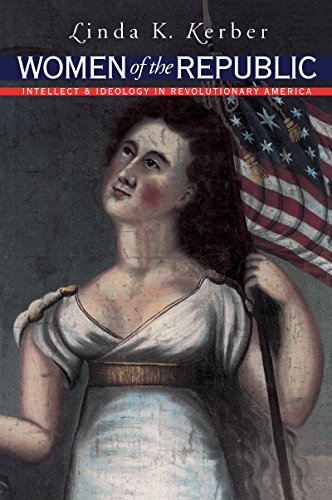
Kerber, Linda K. Women of the Republic: Intellect and Ideology in Revolutionary America. Chapel Hill: University of North Carolina Press, 1980.
CATEGORIES: Cultural and Social History, Early U.S. History, Women’s History, American Revolution, Political History, Intellectual History, American Ideology, Property, Education, Coverture, Republican Motherhood
PLACE: Early United States
TIME PERIOD: 1768 to 1810
TAKEAWAY: Middle- and upper-class white women participated actively in the Revolutionary War and found their rights curtailed by the Revolution, contra to the ideology of the war. In response, they developed the “Republican Mother,” an active patriot who encouraged patriotism in her husband and children, especially sons. This allowed them a limited political role for which they must be educated. Women could maintain their private lives while still playing a role in the civic virtue of the republic.
SUMMARY:
While the ideology of freedom and natural rights was central to the American Revolution, Kerber argues in this 1980 classic, that these rights were restricted to men, and that the Revolution was conservative for white women, who saw rights curtailed.
Kerber offers an interesting and quick overview of Enlightenment thinkers on women in chapter one, “EMPIRE OF COMPLACENCY”: The Inheritance of the Enlightenment.” Civic virtue and patriotism were masculine. Women’s qualities, particularly “Luxury, effeminacy, and vice”” were to be avoided. Effeminacy meant timidity, luxury, and self-indulgence, qualities that threatened America’s new liberty.
During the war, however, women had participated fully as makers of American-spun clothing and blankets, boycotters of tea, grapes, and lettuce, political petitioners, policers of hoarding local merchants, home economists, cooks and carers of troops, nurses, and landlords of boarding houses who took in troops and prisoners. Their contributions were little recognized and ended abruptly after the war. These experiences were new for women, and faced with new ideologies of freedom and autonomy, they began to question why their old positions in society had not changed with the new ideology.
During the war, dowers and coverture laws came into sharp focus when women were expected to declare their loyalty to the Revolution instead of following loyalist husbands into exile. Women had to choose between their property and their husbands. Many were horrified by this prospect, and even revolutionaries usually preferred wives remain loyal to their husbands over loyalty to the Revolution.
Coverture continued after the Revolution and, contrary to Mary Beard, equity laws did not make up for the problems of coverture. Equity “eroded slowly and erratically” in the first fifty years of the United States and women’s property legislation was not a trend until the 1850s. After the Revolution, women’s property rights became more complex and access to equity courts was less common, and divorce was difficult to obtain, especially for women. Because American virtue and political participation was based on land ownership, women were fundamentally excluded. Kerber calls women’s lack of political rights an “accidental remnant of feudalism.” Demands for women’s property rights soon shifted into a demand for women’s access to republicanism.
Women’s education was the most successful aspect of “Republican Motherhood.” Educated women had been suspect and mocked, but after the Revolution, women pushed for their own education in the name of educating their sons. Women’s intellectual capacities were not challenged. Instead, reformers argued that a politically independent nation required literate women uninterested in fashion. Though she had no agency in politics, she was responsible for it through her mothering.
Dependent on her husband for income and political representation, she learned in the “service” of her family rather than for her own edification or use. Women did not push against the confined role of women in the home. Instead, they lifted her role to that of virtuous and educated mother.
RELATED:
Bernard Bailyn. The Ideological Origins of the American Revolution, 1967.